Text | Essay | Performing Arts Season 2025/26
“Silence of the Puppets”. The Neo-Surrealist Gisèle Vienne
An essay by Marietta Piekenbrock
Available from 11 November 2025
Reading time ca. 7 min
German and English

The world of artist Gisèle Vienne is full of taboos and locked-away secrets. She is a master of uncomfortable silence. For 25 years, she has been applying her own carefully crafted approach to everything that is kept in check behind the scenes of success, logic and reason. Her spaces and silhouettes tell stories of manipulation, loneliness, abuse and violence through an aesthetic of absence. And yet the effect of her productions, whether on stage or in a museum, is not one of oppression, but rather one of liberation and empathy.
Inspired by her mother, sculptor Dorothéa Vienne-Pollack who studied under Kokoschka, and trained at the École Nationale Supérieure des Arts de la Marionnette in her hometown of Charleville-Mézières, Gisèle Vienne (born 1976) came to theatre and the visual arts through puppetry. Based in France and with Austrian roots, she has become one of Europe’s most important artists, amalgamating everything that characterises the continent in her oeuvre. She integrates history, philosophy, literature and science as the foundation for exploring the traces of violence in the bodies and psyches of individuals and communities – be it a family (“Der Teich”), a trainer with a young athlete (“This Is How You Will Disappear”), a raving mass (“Crowd”) or a group of people waiting (“Showroomdummies”). Each work, whether stage production, photography, film or sculpture, presents a new experimental arrangement, leading the audience almost physically into the difficult-to-access realms of sleep, speechlessness and trance.
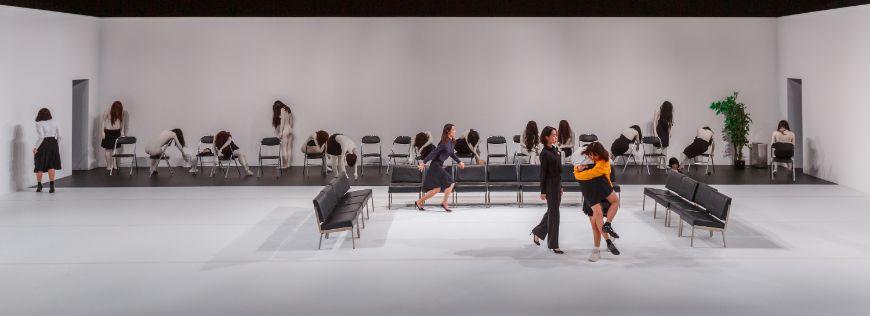
Showroomdummies #4, Centre Pompidou 2021
One hundred years after André Breton’s “Manifeste du Surréalisme”, for the Year of Surrealism 2024, an expansive retrospective of the choreographer, director and sculptor’s work were on display across three venues in Berlin. There must have been a contemporary rumbling in the archives, as evidenced by her sculptures in the form of lifelike dolls. Like all dolls in art, they serve as a symbol, a comparative body. They have come a long way. The traces of surrealist motifs become particularly vivid in her early piece “Showroomdummies”.
The vibrant intensity created on stage, the immobility, the silence of human and non-human bodies, their isolation from the sensory structure of social action – all of this draws with obvious sympathy on the surrealists’ depictions of dolls, most recognisably perhaps the staged mannequins of the legendary “Exposition Internationale du Surréalisme”, the photomontages of Dora Maar and the feminine creatures of Hans Bellmer. The extent to which his twisted and newly composed “Poupée” served as an antibody and a response to the uniformed image of humanity in Nazi propaganda art was only recognised in the later post-war years. Similar to Bellmer’s coded comments on Nazi cultural policy, the dolls of Austrian painter Rudolf Wacker are weighed down by the prevailing climate of mistrust and masked emotions. The Surrealists’ gestures of disinhibition had a strong start in 1930s Paris, but almost in parallel, the “Degenerate Art” exhibition, which opened in Munich and then in Berlin, set in motion one of the worst campaigns of exclusion imaginable for the progressive approach to images of the body and gender. Wacker’s “Puppenköpfchen mit Sprüngen” (1937) becomes the defining image for the state of modernity: damaged! In Gisèle Vienne’s series “40 Portraits” (2003–2008), which depicts teenagers in a gallery of individual photos, we see this pictorial tradition laid bare.
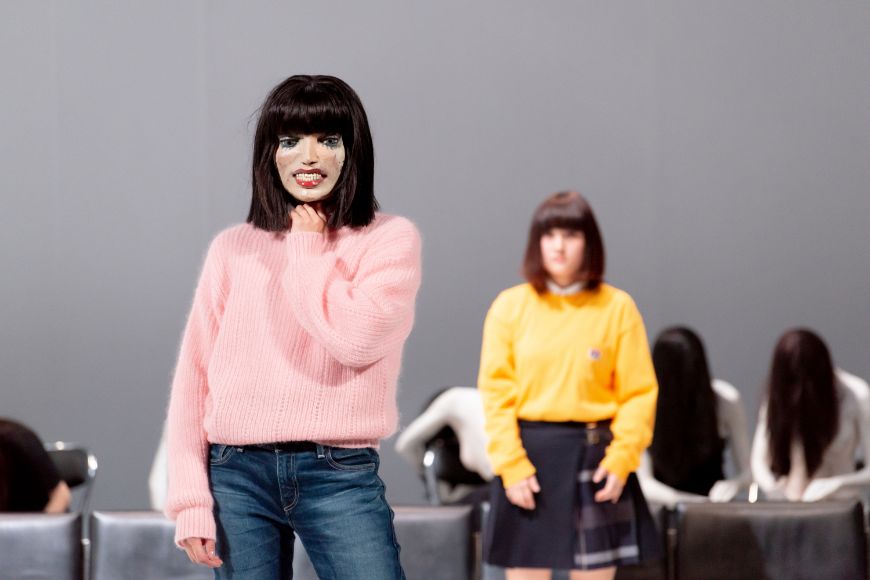
Showroomdummies #4
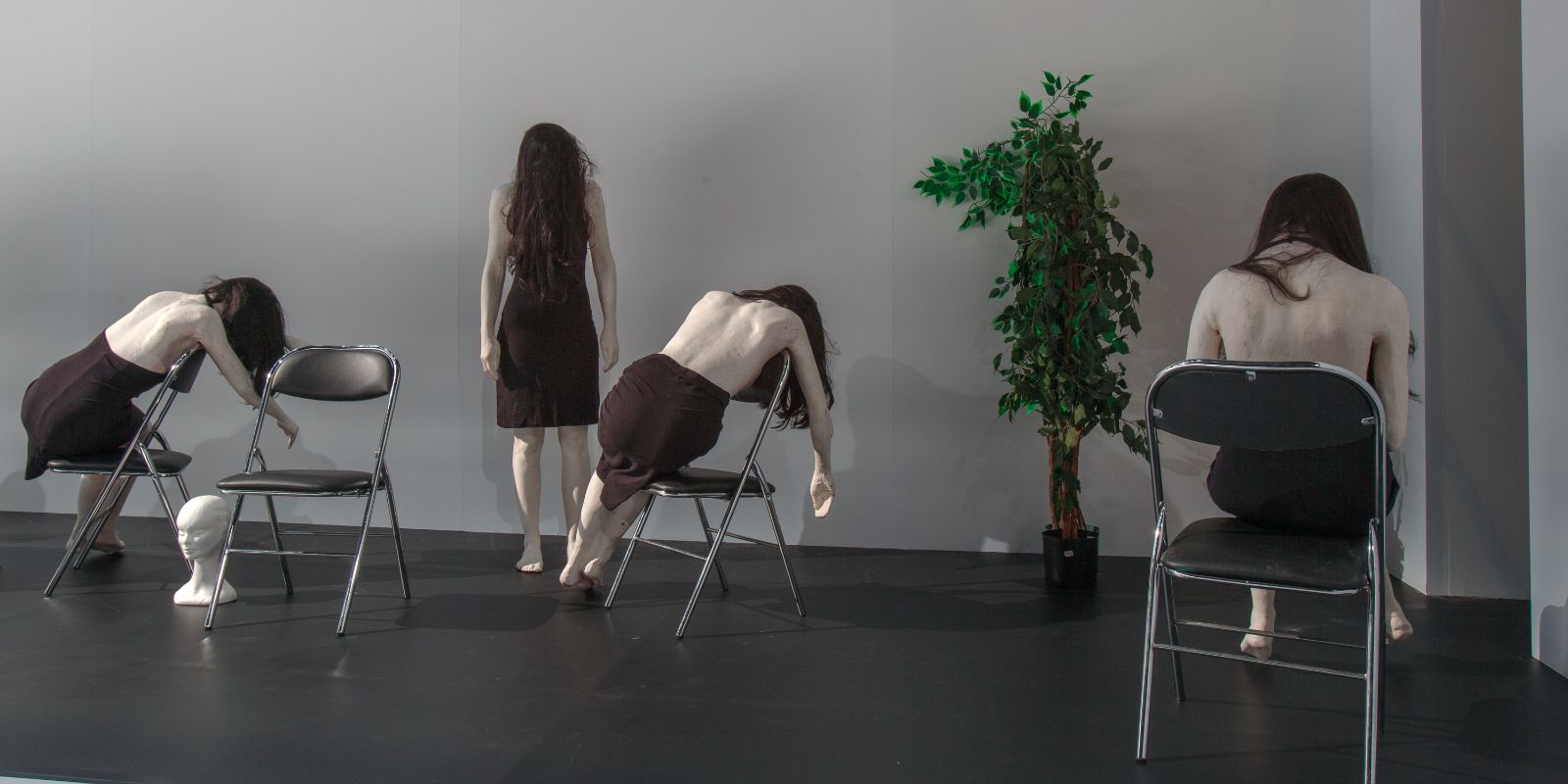
In “Showroomdummies”, the artist’s sculptural working method manifests itself live in front of the audience. She choreographs the dolls into a hypnotic tableau vivant of women who curve their bodies, letting their heads sink in melancholy. The title, the black-and-white aesthetic and the individually customised mannequins draw associations to the productions of Man Ray, Dora Maar and Hans Bellmer. The play is inspired by Leopold von Sacher-Masoch’s novella “Venus in Furs” (1870), specifically by the female character Wanda von Dunajew. Gisèle Vienne’s direction focuses on the provocative, bipolar eroticism of a woman who is manipulated by her lover like a lifeless marionette, only to begin manipulating her surroundings herself in the next moment. While Sacher-Masoch’s story is set in the salons of the bourgeoisie, Gisèle Vienne has found a contemporary counterpart. Her stage depicts a kind of 1960s airport lounge – a modern metaphor for the motif of waiting and delayed time. Empty faux leather armchairs form an aureole exhibiting patterns and conditions for contact. Sacher-Masoch’s art of suspense is sketched out in the suspended, drawn-out gestures of her performance.
The performers take their places among the dolls, merging with them to form a visual unity. Only when they slowly detach themselves from the group and take their seats in the lounge does it become clear who is human and who is sculpture. A kind of slow-motion effect makes the details and individual movements visible in relief. “What do these representations tell us when we perceive them as subjects?” asks the artist. “Their absence, their immobility, and their silence speak to us and can be seen as gestures of rejection. Gestures of rejection towards a culture that wanted to silence them. My productions aim to let the audience see and hear what a body, which is culturally perceived as an object through its various representations, has to say once it is perceived as a subject.”
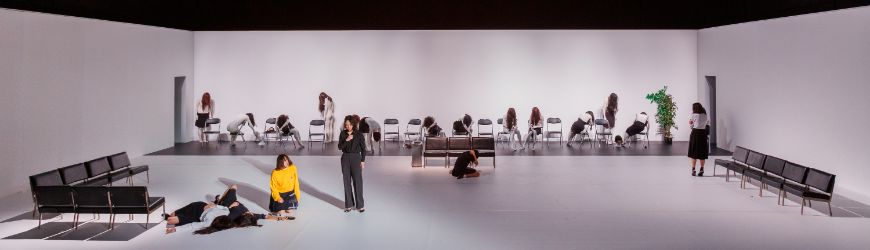
Showroomdummies #4, Centre Pompidou 2021
The performance shows us, a director who wants to tell stories has to believe in something extraterrestrial, in a protective power, an imaginary double. This is the secret heartbeat of theatre and puppetry; this is where the opportunity lies for the intoxicating creation of a new form, a kind of neo-edition of ourselves. Gisèle Vienne lets us watch as she allows the history of art to wander through her subconscious. With her contemplative gaze and her maximum-impact images, she lends a strongly sensual dimension to the process of seeing, making every detail equally important. As a viewer, one is drawn into the action, while the broken and dead come to life before our eyes.
Marietta Piekenbrock is an author, curator and cultural manager. Her most recent publication is the artist monograph “Nahaufnahme. Boris Charmatz” (Alexander, Berlin 2024). She has been following and promoting the work of Gisèle Vienne for many years.