Text | Essay | Performing Arts Season 2025/26
As Much Life as Possible
Notes from the rehearsals for “Dancing Idiots” by Dan Kolber, dramaturg of the production
Available from 18 December 2025
German and English

One of the first rehearsals for “Dancing Idiots” took place without the actors. It was a rehearsal to practise the opening scene, when wooden beams drop from the ceiling. My first impression: the stage comes flying in.
The play, which ends in absence, begins with a creation: the making of space. From light and the crash of boards, a world takes shape before our eyes. Hard and edgy, this world seems inhospitable, and yet it is also gentle. The first living creature appears, a cat.
Sebastian Blomberg is staring ahead on all fours. The cat brings along its own silence. Its eyes witness things we cannot see and its ears pick up sounds that our human ears cannot hear. We sense the cat’s attention being drawn to things beyond our perception. Another reality seems to surround it. The cat is crouching just in front of me. Its gaze glides past me. It does not seem to perceive me as a person. I am of no importance to it, yet it never treats me as if I were absent. In rehearsals, Sebastian Blomberg seeks to capture this fascinating indifference of a gaze – one that expects no glance in return. What strikes me as beautiful is not only that a cat appears in the play, but that an actor can evoke in me a sensation I otherwise know only from the presence of a real animal.
At second glance, I notice the human eyebrows, the nose, the mouth and the beard. The foreign and the familiar suddenly merge, like a sphinx. For a moment, Sebastian Blomberg is neither simply human, nor merely a cat; he appears as a hybrid creature. I am reminded of one of the oldest known works of art in human history: the Lion Man of Hohlenstein-Stadel. Carved from mammoth ivory some 40,000 years ago and measuring around thirty centimetres in height, the sculpture depicts a human figure with the head and limbs of a lion. To this day, its meaning remains unknown.
The seemingly hostile world contains food. The cat discovers a fish and devours it. As domesticated predators, cats resemble the humans in this piece. The quest for life in one animal means death for another. Set to the rhythm of chewing, swallowing, gagging and smacking, I witness the crushing of a living creature during a morning rehearsal. When I see the remains of the fish in the cat’s open mouth, life and death collapse into a single image. In this play the lovable and the dangerous are never mutually exclusive; they are either present at the same time or reveal themselves in rapid succession.
Theatre without animals is a world with a strange void. The emotional range of theatre is often confined to the human. And yet, in this performance, the first and last character to appear is a cat. The absence of humans allows me to see them differently once they do appear on stage.
Each character in this play is defined not only by what they say, but by their bodies – their physical presence and condition. Goldie, whose consciousness is marked by strength, inhabits a body that steadily weakens until it becomes completely immobile. Apollo, the cat, lives in a body fundamentally different from our own. Tony and Vivian, bearing the marks of age and a long life, set out to explore one another’s bodies; discovering bullet holes, scars and wedding rings that speak of who they are.
In this play, the elderly are the survivors. The zest for life is not bound to age. Vivian and Tony do not settle for less in their old age. Karin Neuhäuser and André Jung attempt to practise kayaking in Goldie’s room and for a moment they succeed, gliding weightlessly. Although this feels like a kind of happy ending in the middle of the play, the future of this couple is uncertain and fragile.
We all die on a construction site. We die unfinished. The construction site reveals that Goldie is both preparing for her death and fleeing from it. She believes she will be able to die more easily in the remodeled room. At the same time, the building materials and tools embody a confidence that she will remain alive, to keep building, to keep transforming the world. The wooden boards Goldie clings to are an escape into a confidence that, being mortally ill, she can no longer sustain.
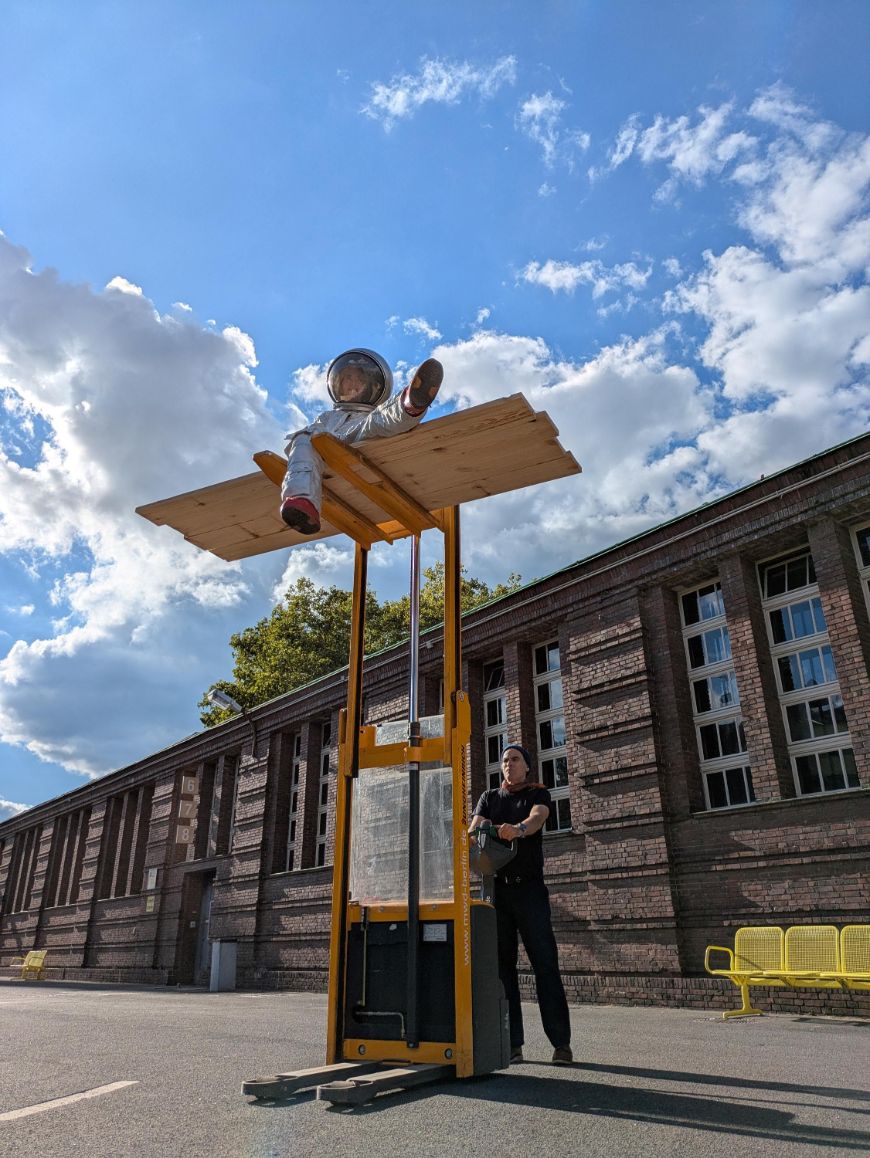
The first astronauts on the moon were beginners, like anyone who is dying. Both are exposed to the unknown, dependent on help at every moment. The NASA logbooks reveal that humanity’s encounter with a completely different world also has a comical side. Goldie’s moon landing draws largely from original NASA quotations.
Denis Johnson wanted to land on the moon himself. He even wrote a letter to NASA, applying to become an astronaut. There are two ways of leaving Earth: by travelling into space and by dying. Goldie’s dying marks the second half of the play. It begins with her departure from Earth and leads us to her final moments. Goldie’s moon landing traces her withdrawal from Earth. Illness has altered her way of seeing the world, setting her apart from those around her. Against her will, she lives in the extreme place that Vivian deliberately seeks out again and again: the place closest to death.
A lifeless body is cold. In the moments before her death, Goldie experiences the warmth of life one last time. In the sauna, in the dance, the body heats up. Goldie’s final dance is not only an expression of farewell, but also a last reminder of the intensity of living.
Actors who play someone dying are performing their own future. At some point, that future narrows to the second before death – the final heartbeat. Lensing uses the tools of theatre to enter this moment and stretch it out, revealing a whole range of human experience contained in this tiny unit of time.
The lives of theatre characters come to an end when the actors no longer play them. That is why Goldie dies the moment Ursina Lardi returns to being only Ursina Lardi on stage. In the final scene, the cat is alone. It waits for Goldie. With each passing minute, the cat gradually realises that its beloved owner will never return. When death is seen through the eyes of an animal, its profound mystery becomes all the more palpable.