Text | Interview | Performing Arts Season 2025/26
“Thikra” Is a Living Organism
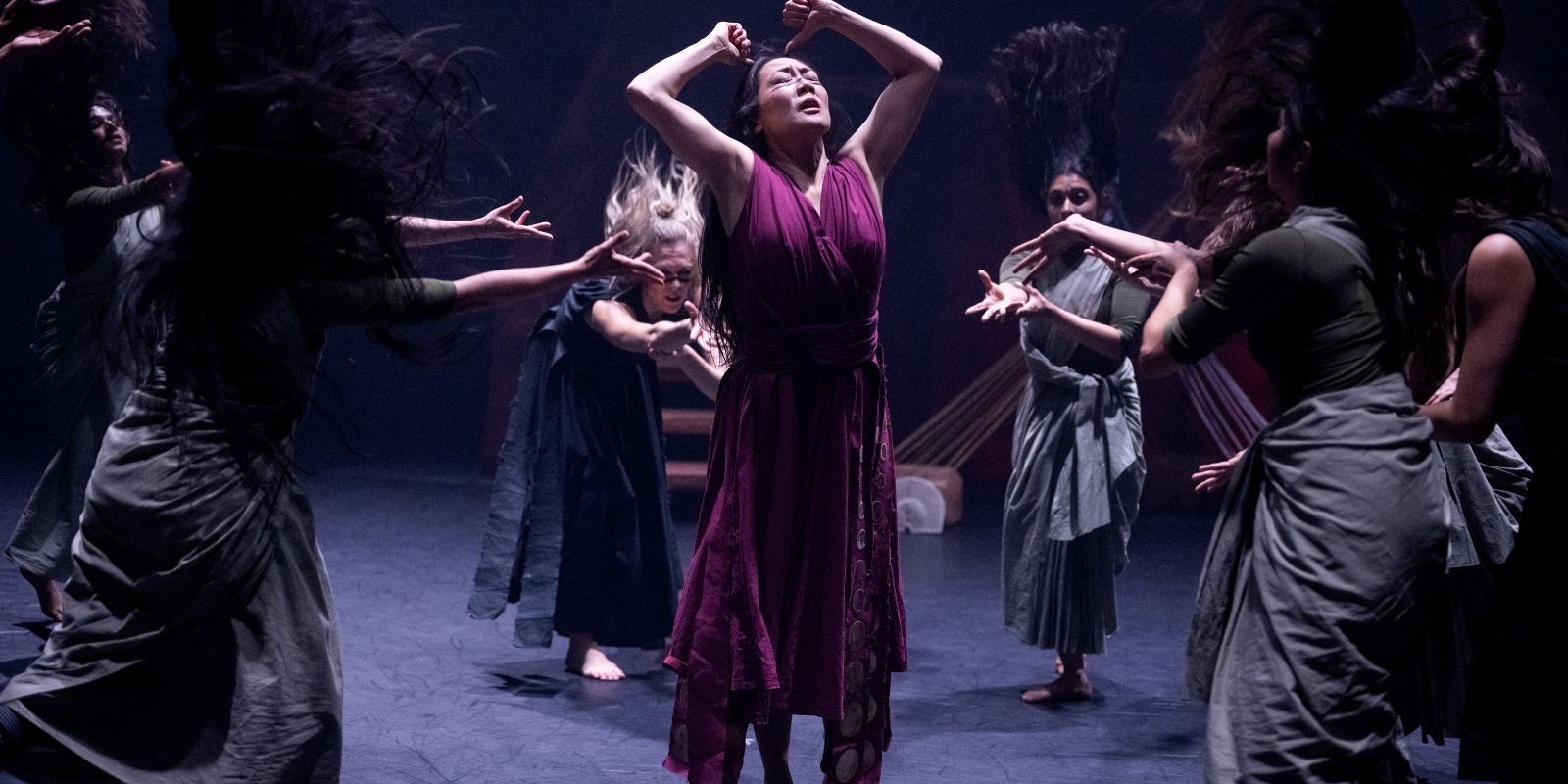
Akram Khan in conversation with Marietta Steinhart
Available from 20 October 2025
Reading time ca. 11 min
German and English

Akram Khan: Oh, if you came to Paris or Berlin you’d be like: What is this piece?! I’ve changed it even more. I’m a snail. I’ve been known to be such an explosive dancer, and yet when it comes to creating, I’m the one who chews on stuff for a long time. That’s the irony of it. It’s like chewing on tobacco or a betel nut. You just chew and chew and chew until something comes out. I take my time to understand my own work.
Are you content with where “Thikra” is at? Will you keep working on it?Yes, of course. When I come in, the whole team goes like “Oh, God, Akram is coming!” (laughs). But I say: let’s embrace change. I come in and I start to discover new things. I change stuff with my lighting designer, the composer, the dancers, things that make sense and, you know, you need to see it and feel it with an audience. That’s when the truth comes out of what works and what doesn’t. That’s a very important part of my process. I would say I’m 2/3 there before the premiere and then the other third, which is probably the most crucial bit, is with the audience.
How do you know when to let go?I don’t think I’ve ever let go. I don’t even know what that concept means. There’s always something to discover. I have three kids and they’re still young, right? But I’m discovering something new about them every day. It’s like that. My shows are my children. Each one is a living organism. And the only difference is that instead of your wife, an entire group of people gave birth to this work. It’s a collective birth. We are constantly growing as we see the work, and we keep questioning it. I think if you love something, you will continue to ask questions. The moment you stop asking questions, you stop loving it.
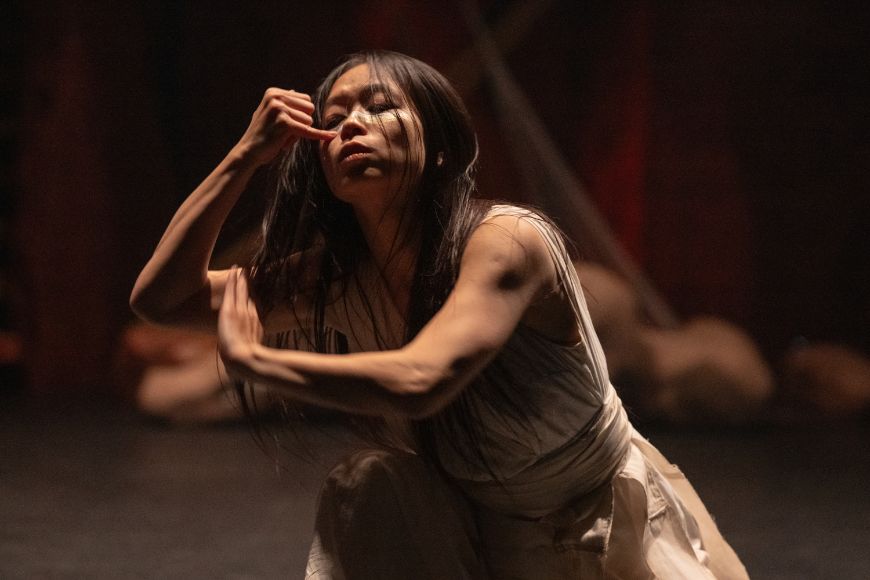
Thikra: A Night of Remembering
That’s exactly what I would have said. That is everything that I’m interested in. It’s freakishly precise. I call the body a “living museum”. The biggest museum we have that’s constantly navigating through time and age and life is the body.
In terms of body memory, I am interested in the belief system and trauma. Trauma really sits in the body in a very deep way sometimes because you cannot articulate it. But it’s there in the body, in the muscle memory, it’s in there. So that’s really something obvious with “Thikra”. That was very important, and it wasn’t so much about trauma, but it came from the idea of “the turning of the bones”, a tradition of the Malagasy peoples called Famadihana. It’s a ritual in which people come together once a year, or once every cycle, and they will unwrap their ancestors’ bones and massage them to give new life to them, then rewrap them in new cloth and return the bones to the grave. It’s incredible.
When I was in AlUla, in the desert, I would put my hand on a mountain in a cave with ancient imprints from Judaism, Islam, Christianity and the Nabataeans. You have all these cultures that passed through and lived there. This mountain is also a body. It’s like the Chauvet-Pont-d’Arc Cave in France, you know? But it’s not the handprints that interest me. It’s the thing that embodies and carries the handprints. It was Manal AlDowayan who introduced me to Nabataean culture. We went to meet a friend of hers and her granddaughter started dancing for me. A lot of the opening scene in “Thikra” was inspired by her.
I was just fascinated by those women and their stories. I really see the world through many viewpoints, but the biggest influence was Peter Brook.
I thought your biggest influence was your mother.The patriarchal notion came from Peter Brook, and the matriarchal perspective came from my mother. I look at all my stories through my mother’s gaze. Those are the two lenses that I kind of fused together.

Thikra: A Night of Remembering
I know it’s ironic, right? There’s so much hair dance and I don’t even have any (laughs). There’s something about the symbolism of hair. The power that these women have, it’s all in the hair. It’s a weapon. But also, it’s nature and it’s nurture. It has so many meanings, and I was excited by that. There are lots of little myths about those women that we collected from that region, and Manal and I created our own story.
You’re best known for blending Kathak with contemporary dance. For “Thikra” you worked largely with dancers specialized in Bharatanatyam, another Indian classical style. Why?Because within the Bharatanatyam dances there is a rigor and belief system towards the invisible. They deeply believe in God. But you can’t show me God, right? It’s invisible. My mother can’t show me love. But I know she loves me. And I now know what that means. I would do anything for my children. There’s something about the invisible and the intangible that fascinates me. I approach everything in a metaphoric and spiritual rather than a linear and visible way. I understand that’s difficult for some people who come to see my shows, but I’m interested in not showing the meaning of my work but allowing people to feel the meaning for themselves.
You’re trying to achieve something that sounds nearly impossible – if I may say so. You’re trying to make the invisible visible. How?I don’t know. I succeed and I fail on many projects. It’s really hard – and it’s daring. You put yourself in a very compromised situation because we’re living in a “If I don’t see it, I don’t believe it” kind of world. People are not interested in context. We tend to simplify things. The world is divided into likes and dislikes. Those are the only two options you have these days. The simplification makes it visible. The moment you go into a grey area it becomes dangerous, or we are scared – and I grew up in a lot of grey area. Sometimes what you really want to say is what you’re not saying. “Thikra” is a manifestation of all those beliefs.
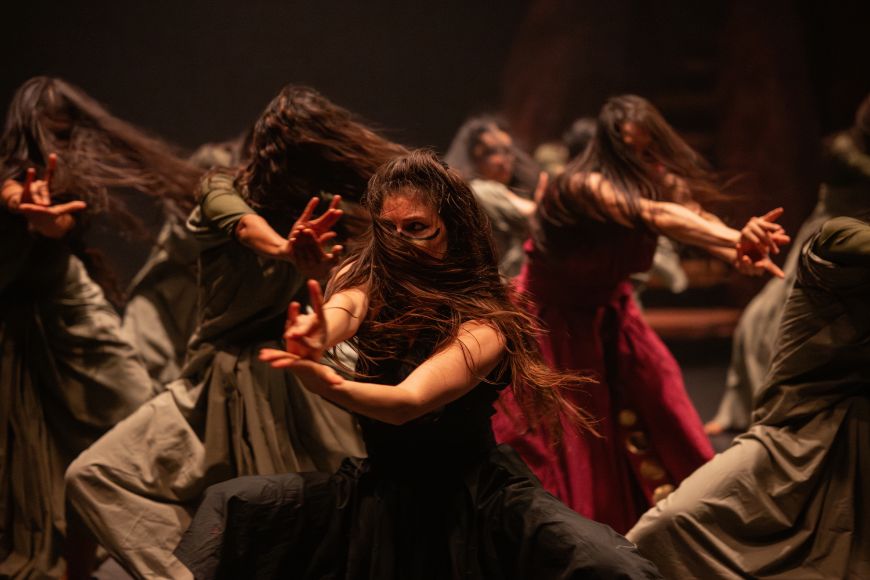
Thikra: A Night of Remembering
The company’s model was about creating, producing and then touring the work. But we’re going to change that. Our reach goes far beyond local and international professional dancers, or ballet, or contemporary, or Indian classical dancers. It’s really huge. And to create a new infrastructure we needed to close the old one.
You are changing the outer infrastructure. What about your inner vision? Your past and future legacy?Throughout those 25 years, literally every step was important but there are certain pivotal moments that really shifted gears. One of them was “zero degrees”, my collaboration with Sidi Larbi Cherkaoui, Antony Gormley and Nitin Sawhney: that showed me the power of collaboration. Another crucial moment was “DESH” because it was the first time I ventured into making a contemporary solo. It’s not like I hadn’t done solos before, but to tell an entire story with my own body, that was a first for me. Another crucial moment was, of course, the 2012 Olympic Opening Ceremony. That really gave me access to understand and experience scale. In the theatre you can see the faces. You can feel the energy. You can feel the sweat. You can smell it. There’s no other scale as large as the Olympic stage.
There were many more important landmarks in my career, but “Giselle” was the first time I told a story that was not my own story. I was nervous entering that world because “Giselle” is so sacred: it is one of the most beloved ballets, especially in England. Then I saw Max Richter’s performance and it completely opened my mind.
However, there’s works that I’ve done – and I won’t mention which ones – that I keep very close to my heart because in my eyes they were failures, and those failures taught me more than anything else could have.
Marietta Steinhart is a culture journalist. After many years in the United States, she now lives and works once again in her home city of Vienna.