Text | Interview | Performing Arts Season 2025/26
About Vocal Incantations, Waywardness and Compounded Time
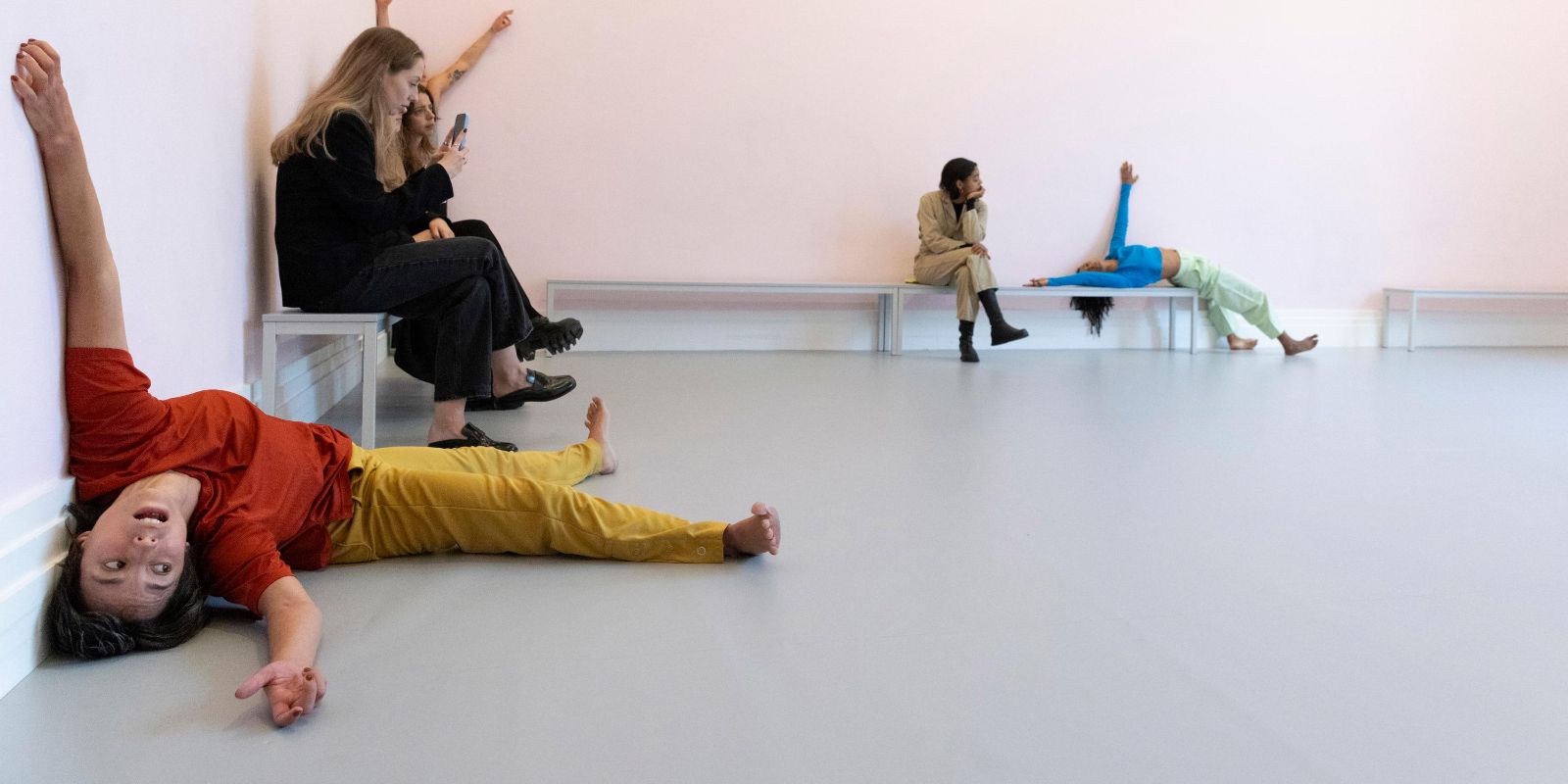
Ligia Lewis in conversation with Nora-Swantje Almes about “Wayward Chant”
Available from 19 November 2025
Reading time ca. 9 min
German and English

Ligia Lewis: “Wayward Chant” appeared to me first as a response to a history that still haunts some of us today. It leans into the tensions produced by a lingering past – particularly felt in spaces like museums, where “history” is always looming. As a Black femme, I feel in constant negotiation with structural erasure or the feeling of being absenced – even while simply existing in space, which lends itself to a feeling of a haunted presence.
The chant is one of the oldest vocal incantations. It has a very simple form. Medieval lamentations have also shaped and sculpted some of my later works, as well as the idea of the medieval landscape as a site of haunting. The Gregorian chant may be the oldest musical form in the West, but early Ethiopian Orthodox chants predate it. Perhaps I’m drawn to the spiritual presence within these sonic explorations. I’ve been drawn to liturgical musical forms in earlier works, inspired by Black American and Caribbean traditions that serve as ancestral spiritual practices shaping contemporary sensibilities. I like the simplicity and earnestness of these sounds. A lot of my work starts from the sonic register and spills outwards towards the visual via light, scenic design or the materiality of bodies in space.
In this work, I want to give voice to a chorus assembled in dissent, which is by no means new for me. I’ve described my processual form as a process of ensembling: bringing different folx together in and through difference, through a shared language, and weaving disparate textures together in nuanced ways. I’m always thinking about the collective – what it means to move or be moved together – hopefully in coalition, as an attempt at evading an otherwise simplistic reduction and movement towards sameness while thinking about how an assembly of bodies in difference can be moved into action. This idea of a choral chant will be driven by a thick and potent performative presence that I hope speaks back to the various ghosts and simultaneous ghosting of Black folx in particular, though not limited to Black folx.
I’m trying to articulate these otherwise negative affects as a form of despair that is mobilised in its insistence or performed demand for transformation. And I know that the term “resistance” has been floating around my practice. Specifically, I look at what could be considered ethics of re-presentation, however at its limit, or what it means to give body to thoughts and affects that might not be deemed productive, including the overwhelming feeling of political disappointment. I engage with the pessimisms that emerge from a fraught psychic space. Through a notion of waywardness – or by way of the chant – I attempt to mobilise these feelings.

Ligia Lewis, Wayward Chant, live performance, Ligia Lewis: I’M NOT HERE FORRRRR…, Gropius Bau, 2025
Waywardness is another way to describe a rebel or someone who is wilful and takes pleasure in their obstinate disobedience. The rebellious nature of these young African American women described in Saidiya Hartman’s book at the turn of the century becomes stories of political will and activism told as a position from below, as Hartman and others describe it. Those are stories that escape the romance of heroism but inevitably describe brilliant acts of radical autonomy despite the odds. Hartman is an important reference for me and many other artists of Colour.
My work is dedicated to those who have historically been marked as wayward, wilful, disobedient, and made “other” by their illegibility or inability to be rendered legible by a dominant order. These words serve as more than descriptors, but as conditions marked by race or gender.
Waywardness also seems to be about what might have been. In your work, you connect histories to the present, particularly in how you work with sound, but also in the bodies of the performers who carry certain histories.
We in the West are trapped inside reductive, restrictive ways of perceiving time, even though the linearity of time has been declared a complete falsehood. It’s a horrible framework that lends itself to the thinking of time as an inevitable movement towards progress. There’s nothing stronger than the Black experience to know that time does not operate that way, particularly for those of us with ancestral ties to non-Western practices grounded in more complex notions of spiritual and material continuums.
I have been making performative collages by layering seemingly disparate elements like musical epochs, theoretical texts and movement vocabularies. I think a more realistic way of how we experience time itself is also how we experience one another. For example, I’m using early church music in “study now steady”. In the West, the church was one of the first implementations of a racial order. The demarcation of time and the symbol of the bell tower are featured strongly in the film “A Plot, A Scandal”. The harpsichord and saxophone are two disparate instruments from distinctively different epochs, which my collaborators George Lewis Jr. and Wynne Bennett used to score the film. I’m thinking how to build these complex collages that give feeling to a compounded time as a texture of density and complexity within the present, or what we perceive as present.
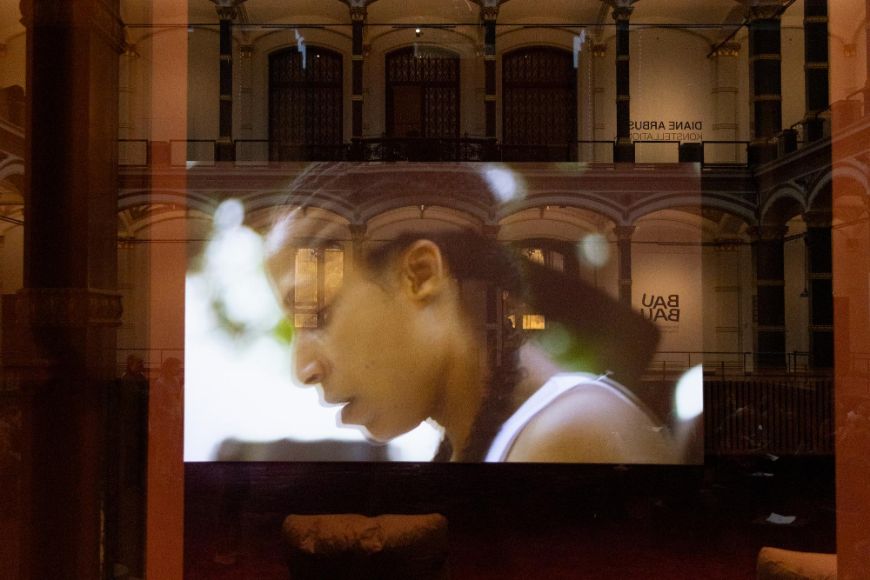
Liga Lewis, A Plot, A Scandal, installation view, Ligia Lewis: I’M NOT HERE FORRRRR…, Gropius Bau, 2025
Totally. It invites a possibility of processuality. The work unfolds as a real-time feeling of an unfolding. This is why escaping a theatrical framing is at times exciting for me because I can play even more with the nuances of how time is performed, mixing real-time engagements with the public but through the duration of an exhibition, in ways that are potentially more dynamic. It gets me closer to an idea I am interested in, “corpsed time”, or time that lingers and haunts. “Wayward Chant” is an iterative work that will unfold as dynamic, dissenting figures appear and disappear, first as silhouettes projected along the frescoes of the Gropius Bau’s atrium as well as a live moving chorus. What I love is the potential for things to look like a mistake, out of joint, or maybe even crazy. Who are these folx that capture a space of lingering both in the centre and edges of space? I love this ensemble that I’ve chosen for this work. We are moving in what performer Navild Acosta described as extravagant nothingness, and what I like to call “luminous fuckery” – the only way for me to get at the sheer silliness of our times.
So, it is a very playful yet cryptic work that begins very gesturally, like the figurations along the wall. My work on silhouettes or two-dimensional figuration is inspired by some medieval paintings, for example Bruegel’s “Triumph of Death”, and some other painters I really like, Paula Rego and Lynette Yiadom-Boakye. I am interested in figuring a kind of tragic everydayness, gestures sculpted through distortion and performed in their spectacular mundanity and flatness.
Generally, people would think that you would want bright lights to centre the Black figure as Muse. What Lynette Yiadom-Boakye’s painting does is quite the contrary. It’s like her figures recede into the landscape of the everyday, the postures gorgeously regular. You can’t catch the entire contours of her figures as the space appears to fold around her figures and hold them. She gets at the fleshly, porousness of a body – it’s another way of reading or feeling a body. Applying this idea of figuring to the piece in the atrium, the carpet creates a kind of canvas. Figurations are constantly unfolding, very playfully and in a fugitive manner. There is both a shiftiness as well as a “I don’t give a fuck” kind of posturing. Right when you think that you have something, it’s fleeting.
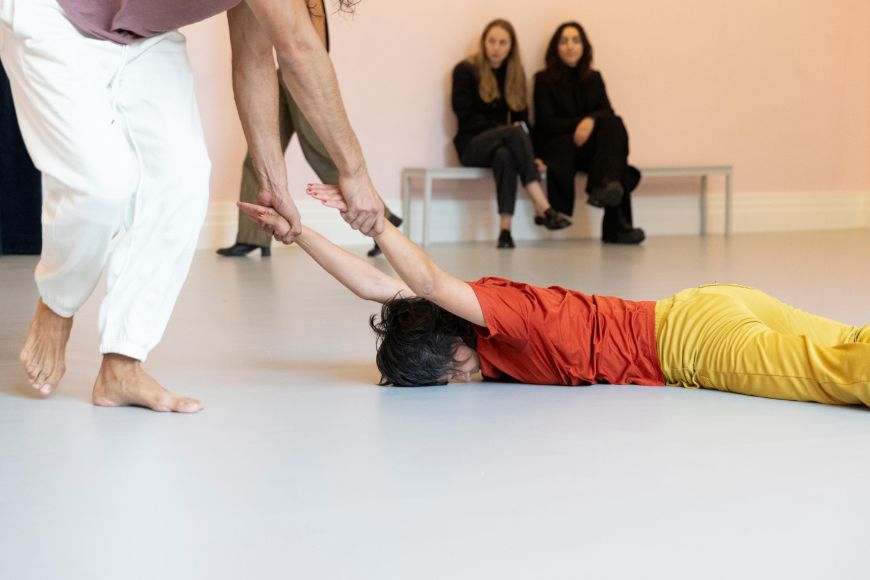
Liga Lewis, study now steady, live installation view, Ligia Lewis: I’M NOT HERE FORRRRR…, Gropius Bau, 2025
So much of my work is working in consideration of the gaze and against it. The knowledge that appears in the shadows tends to be more compelling to me. It’s a result of being sensitised to another way of being in the world.
In surveillance culture everything is evidenced through the visual and the whole racial regime is built on the misrecognition of being seen. It’s deeply embedded in the structures of seeing. I’ve always resisted the lure of visibility politics. The way identity has been folded into visibility is violent and full of more erasure. So yes, I love shadows. They are fugitive gestures that give voice to complex feelings – how to hold onto the complexity of Black being. I’m also trying to always off-spell all of the potential capturing of Blackness through violent optics or through reduction.
You mention the dance of the dead as an inspiration – albeit in a reimagined form. What does that mean for “Wayward Chant”?
Danse macabre claims a universalizing language: “we are all equal in our graves.” My work breaks with that myth and centres the conditions of unequal life and thus death for those of us raced Black. This idea of corpsing or deadening things appeared to me a long time ago (“deader than dead”, 2020) as a way to transform liveness into a play of the dead, or rather deadening logics that have overdetermined who we are. Out of respect for the dead and the living under violent forms of racial capitalism, and out of respect for the invisible or those that can’t speak, I work with deadpan and deadness as a way to kill the institutional burden of representationalism and to create something more haunting and strangely more to the point.
Nora-Swantje Almes is a curator and author. She works as part of Gropius Bau’s curatorial team.