Text | Essay | Berliner Festspiele 2026
75 Years Experimenting with Freedom
Another short history of the Berliner Festspiele
75 years ago, Berlin’s culture wars were being fought out openly in street battles. In August 1951 the Free German Youth (FDJ) in the Soviet sector of the city hosted the third World Festival of Youth and Students.
Available from 30 April 2026
Reading time ca. 20 min
German and English
However it was not in a position to provide for the over two million domestic and foreign visitors, so Ernst Reuter, the Governing Mayor of West Berlin, arranged makeshift soup kitchens for tens of thousands of people and also arranged for hundreds of thousands of books and theatre and cinema tickets for the Western sectors to be distributed to the young left-wingers. This caused considerable resentment in the GDR, and the party leadership was angry with the FDJ chairman at the time, Erich Honecker, which resulted in him sending several detachments of agitators to West Berlin on 15 August. Groups of up to 10,000 FDJ members marched in uniform through Wedding, Kreuzberg and Neukölln, chanting in chorus, handing out leaflets and getting into fights with the police. The latter brutally clubbed down almost a thousand young people, and eleven policemen were injured in the process. Before this, the Interior Minister of Hesse had declared any form of advertising for the World Festival to be unconstitutional and banned it; many Western visitors were prevented from attending on their exit from or transit through the FRG.
But soup and free tickets were not the only ways in which the West wanted to demonstrate its cultural and material superiority in Berlin. After the CIA, the US foreign intelligence agency, had approved the foundation of a congress for anti-Communist youth, the “Congress for Cultural Freedom” (CCF), the previous year, the Western allies initiated and financed two new cultural festivals before and after the Stalinist World Festival of Youth as “windows onto the West”: the Berlin International Film Festival in June and the Berliner Festwochen in September. To compete with World Festival stars such as Pablo Neruda, Jorge Amado, Ilya Ehrenburg and the Soviet prima ballerina Galina Ulanova, Alfred Hitchcock and Juliette Gréco featured at the first Film Festival, soon to be called the “Berlinale” – at which “socialist films” were explicitly excluded. Walt Disney’s Cinderella won both the audience prize and a Golden Bear. At the open-air Waldbühne films were screened for audiences of up to 25,000 people. The Americans named the former Assistant to the Reich’s Film Chamber Alfred Bauer as its first Festival Director, even though his Nazi past was already known and did spark some individual protests. However, at that time in the West “pragmatic” thinking dominated in all areas and the field of culture was another in which there was a dearth of experienced managers untainted by the past.
The first directors of the Berliner Festwochen were Heinz Tietjen and Gerhart von Westerman. Tietjen had been a distinguished conductor and artistic director of theatre and opera houses for several decades, whom Hermann Göring had appointed to the Prussian State Council in 1936 along with Gustaf Gründgens and Winifred Wagner had installed as Artistic Co-Director of the Bayreuth Festival two years earlier. He is now viewed as an advocate and leading pillar of Nazi cultural policy. Westerman had been Director of the Berliner Philharmoniker during the Nazi period (and again from 1952 onwards), which was placed under the aegis of Propaganda Minister Joseph Goebbels as the “Reich’s Orchestra“ in 1933 and as part of its alignment with the regime he was forced to accept a redefined position which required him to ensure that the orchestra’s management complied with Nazi bureaucracy. Now, on 5 September 1951, the Philharmoniker opened the first Berliner Festwochen at the Schiller Theater, conducted by Wilhelm Furtwängler. They played Beethoven’s Ninth Symphony with Schiller’s Ode to Joy in the fourth movement – a popular concert programme that had also been heard in April 1942 to mark the Führer’s birthday, an event that had contributed to the criticism and initial performance ban that Furtwängler had received after the war. The 250 other dance and theatre performances, sporting events, concerts and art exhibitions of the first Berliner Festwochen in September 1951 were seen by a total audience of more than 150,000 people – two thirds of whom attended the “Day of Sensations” at the Olympic Stadium billed as a Monster Variety Show.
Flags of Freedom
Flags of freedom flew consistently over the festivals and artistic and cultural programmes through which two systems competed. Freedom from capitalist exploitation on one side, freedom from Communist oppression on the other. On the plus side, it was a contest between two positive notions of freedom: on one hand the ideal of individual self-realisation in a consumer society where opportunities might be unequal, but the most liberal-minded, worldly and open approach prevailed. On the other hand, the state-decreed aim of overcoming the lure of individual happiness and success in favour of the collective development of a solidary society of “new” and equal people.
Both models of society were equally abstract because the aspirations of the ideas of humankind they were based on were very different from reality, from the everyday experiences of most citizens. The theatre director Frank Castorf summarised this as follows: in the East no one could criticise the government, but they were allowed to criticise their boss as much as they liked, in the West it was the other way around. Art and culture enjoyed special status in both German states due to the assumption that that the various arts and cultural events allow the potential of individuals and the possibilities for society to be simulated, explored and anticipated, i.e. experienced emotionally in advance.
The fact that the East of the country relied on state guidelines, exclusion and open censorship, while in West Germany unrestricted artistic freedom enjoyed constitutional status and unpredictable, oppositional art that was critical or even opposed to the state could and should be encouraged, was of course a vast distinction and ultimately perhaps the decisive one. When the World Festival of Youth and Students was held in East Berlin for the second time in 1973, this time with Angela Davis, Miriam Makeba, Yasser Arafat and Franz Josef Degenhardt, Honecker had rised from Chairman of the FDJ to become First Secretary of the SED Central Committee. For the eight million visitors the wall that had since been constructed now made it impossible to undertake culinary or cultural visits to the West. The state security apparatus was also capable of preventing any criticism of the Party or socialism from the outset due to its comprehensive infiltration and surveillance of the cultural scene.
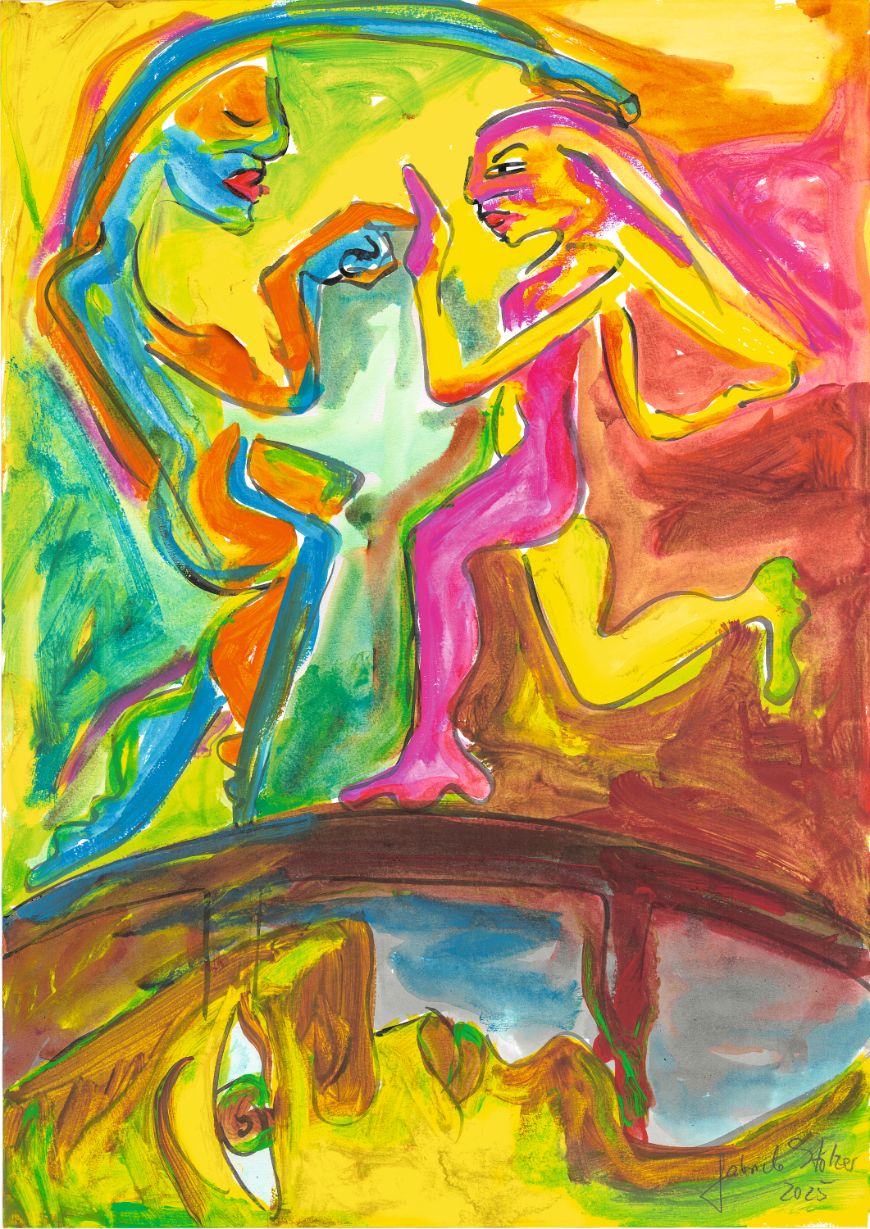
3,500 people were arrested in advance, moved out of the city or placed in psychiatric institutions. Three years later the artist Wolf Biermann would have his GDR citizenship taken away. The Erfurt-based artist Gabriele Stötzer, whose works are presented by the Gropius Bau in a major exhibition from the middle of June and who has designed the anniversary poster for the Berliner Festspiele overleaf entitled “Meeting on the Bridge” was arrested in 1976 for gathering signatures against Biermann’s expatriation, charged with “slandering the state” and sentenced to one year in Hoheneck women’s prison.
Bridges to Freedom
The fact that political exploitation and influence and even attempts at covert control also affected cultural institutions in West Berlin for long periods, undermining freedom of expression is the downside of its role as a shop window. In 1964 the composer Nicolas Nabakov, who was also General Secretary of the CCF, became the fourth Director of the Berliner Festwochen and initiated the Berliner Jazztage (which later became Jazzfest Berlin) – the CIA considered jazz to be an important cultural ambassador for the free world and musicians such as Louis Armstrong, Dizzy Gillespie and Dave Brubeck toured the world for the U.S. State Department as “jazz ambassadors”. This was also the period when the Theatertreffen was born (initially it was called the Berlin Theatre Competition), to which GDR theatres were invited for the first time at the third edition in 1966 with the Deutsches Theater (The Dragon by Yevgeny Schwarz directed by Benno Besson) and the Berliner Ensemble (Brecht’s adaptation of Coriolanus directed by Manfred Wekwerth and Joachim Tenschert) – though, of course, the two ensembles were not permitted to perform in West Berlin.
Nevertheless, it would also cost Nabokov his job with the Berliner Festspiele GmbH, the umbrella organisation newly founded in 1967 made up of the Festwochen, Berlinale, Jazztage and Theatertreffen – whose funding was divided equally between the West Berlin Senate and the Federal Government – when he proposed a new international festival format that would bring artists from the Eastern block together with those from the “free West”. He was succeeded as Director by a TV presenter from ZDF, the editor of what was then the highly conservative culture magazine aspekte, Walther Schmieding.
By contrast, the Berlinale – still under the artistic direction of Bauer – was threated with closure in 1970 in light of the fierce protests against the withdrawal of the Michael Verhoeven’s film about the Vietnam war o.k. which was branded “anti-American”: the competition programme was suspended, the international jury resigned (Schmieding also offered his resignation) and the festival’s future the following year could only be rescued by founding an independent “International Forum for New Cinema” in which from now on less commercial films and those that were excessively critical of capitalism could run out of competition and in a so-called non-national section. Under the leadership of Erika and Ulrich Gregor, the Forum developed into the Berlinale’s powerhouse for emerging talent and would present debut and early-career films by Jacques Rivette, Chantal Akerman, Jim Jarmusch, Béla Tarr, Theo Angelopoulos, Wong Kar-Wai, Ulrike Ottinger and Aki Kaurismäki.
Shaping Freedom
In 1973 the former cultural adviser in Bonn Ulrich Eckhardt took over as Director of the Berliner Festspiele. The hitherto most effective phase in the history of the institution since its inception is associated with him and his 27 years in office. This period coincided both with the Federal Republic’s policy of detente with the GDR and the other states of the Warsaw Pact and with the aesthetic innovations and new avantgardes in New York and the cities of Eastern Europe, with “culture for all” as well as with establishing new music and art from beyond Europe with a broader Western public. Eckhardt was not only a courageous and curious curator and art promoter, but he also soon became Berlin’s busiest and most successful cultural politician, a genuine shaper of civic culture who was in constant contact with the key players on both sides of the Iron Curtain as well as with numerous co-operation partners. This gave the Berliner Festspiele great scope for innovation and lent its institutional commitment to artistic freedom a new powerful and creative dimension.
Eckhardt was convinced: “Of all the German cities, Berlin is a workshop to examine tradition and develop what is to come.” He therefore focussed on major themes, particularly in exhibitions of art and cultural history that were accompanied each year by specially devised co-operative programmes and projects in interdisciplinary and cross-institutional workshops. With the Akademie der Künste and its “Secretary“ for Music and the Performing Arts, Nele Hertling, in his early years in office he opened up Berlin to new forms of international dance and performance art (then called “mime”), though both of these picked up on pre-war traditions that had been violently broken off by the Nazis – such as expressive dance. With the curator and exhibition maker Gereon Sievernich Eckhardt produced Horizonte festivals of world cultures in the old Kongresshalle, and following its collapse and reconstruction he would subsequently play a key role in securing the building as a permanent home for the Haus der Kulturen der Welt (HKW). Art, theatre and music from Central and Eastern Europe developed into another key theme of the Berliner Festspiele, with a special focus on the countries that were then still constituent republics within the Soviet Union.
As the Senate’s appointee in charge of the celebrations for Berlin’s 750th anniversary in 1987, Eckhardt pressed ahead with the opening of the Chamber Music Hall in the Philharmonie and also – together with Andreas Nachama and Reinhard Rürup – the exhibition Topography of Terror (which would later become a foundation and permanent documentation centre) on the site of the former Gestapo headquarters next to the Martin-Gropius-Bau, where he had been able to realise headline exhibitions since it reopened in 1981 (Preußen – Versuch einer Bilanz; Jüdische Lebenswelten; Berlin – Moskau / Moskau – Berlin 1950 – 2000). He also commissioned the Hamburger Bahnhof as a new exhibition space, performed large-scale music theatre spectaculars at the Grosser Stern and arranged seemingly never-ending parades of ships on the waterways of both East and West Berlin.
When the Governing Mayor of West Berlin wanted to know what “the people in the East” were cooking up, he would call Eckhardt. The mayor himself was forbidden to speak directly with the East Berlin civic authorities, Eckhardt negotiated everything that needed to be done on his behalf. In May 1989, after being neglected for selection for 20 years, GDR theatres were finally allowed to come to West Berlin for the Theatertreffen with Heiner Müller’s Lohndrücker and Volker Braun’s Übergangsgesellschaft (directed by Thomas Langhoff). In this way the Festspiele changed from having once been a frontline institution of the Cold War to become a great cultural bridge-builder – which may have been crucial in determining that for them reunification in 1990 did not mean “mission accomplished” but that their work would continue and they would be able to evolve into the international artistic meeting point that they continue to be seen as today.
Torsten Maß and Francesca Spinazzi, who until 2000 had both been responsible for numerous of the Festspiele’s (mainly theatre) programmes under Eckhardt, would some years later, when running the Theater der Welt festival edition in Halle an der Saale, choose as their motto the first line of Friedrich Hölderlin’s elegy Der Gang aufs Land: “Komm! ins Offene, Freund!” (Come into the open, my friend!). It is an equally appropriate title for the last third of the Berliner Festspiele’s 75 years of freedom. After Eckhardt had successfully rescued the institution in the reunified Germany of the 1990s, the Festspiele passed entirely into the ownership of the federal government in 2002, and together with the Berlinale and the HKW, they were reconstituted as the “Kulturveranstaltungen des Bundes in Berlin GmbH”. The year-round performances that have since been presented at the festival theatre in the former Freie Volksbühne in Wilmersdorf and the use of the Martin-Gropius-Bau as a permanent exhibition venue have raised the profile of the institution’s current structures and continuities.
Joachim Sartorius and Thomas Oberender each ran the Festspiele for ten years, gave them a distinctive aesthetic and opened them to new artistic formats and ways of working. The Festwochen gave rise to Musikfest Berlin and spielzeit’europa (followed by the festival Foreign Affairs and the Performing Arts Season), while the former East Berlin Biennale for Contemporary Music, which had been integrated into the structure of the Festspiele after reunification along with its directors Heike Hofmann and Ilse Müller, evolved into the festival MaerzMusik. By constantly changing their skins, challenging and renewing themselves, the Theatertreffen and Jazzfest Berlin have been able to maintain their undisputed positions in the festival world – and young people from all over Germany apply for four different youth festivals spread throughout the year – the Treffen junge Szene. Sociopolitical issues and locations in the history of the city, the state and the world have always played a central role in the Festspiele’s programming, whether it be in the Berliner Lektionen, in the performative and discursive reconstruction of the Palast der Republik or the temporary artistic revival of the Internationales Congress Centrum Berlin (ICC) – and in the last three years under my direction with Reflexes & Reflections, the festival Performing Exiles and Radical Playgrounds at the Gropius Bau.
Withstanding Freedom
Only the question of freedom remains suspect. As a test of bravery, as self-deception, as a culture war, depending on who you talk to. If we look at it in more fundamental terms, it can be measured by our powers of resistance. What can we withstand, put up with, tolerate or even accept? As individuals, as a society, as a (cultural) institution, as a state. “Wolf Biermann was and is an inconvenient poet. This is something he has in common with many poets from our past,” the twelve GDR authors led by Stephan Hermlin wrote in their letter of protest against Biermann’s expatriation in 1976. “Our socialist state, mindful of the words from Marx’s 18th Brumaire, according to which the proletarian revolution constantly criticised itself, must by contrast with anachronistic forms of society be able to tolerate such inconvenience with calm reflection.” And Meron Mendel, who together with Saba-Nur Cheema has curated Reflexes & Reflections for the last three years just shook his head incredulously during our preparations for the first edition in 2024 entitled 7 October, the War in Gaza and the Debate in Germany when we presented them both with our de-escalation plans, security measures and awareness concepts in case of potential protests or disturbances.
And asked: “When did you start being unable to put up with that? Where’s your resilience? You’re the Berliner Festspiele!”
And with that he didn’t just mean the Berliner Festspiele. But the whole underlying order of freedom and democracy.