Text | Interview | Musikfest Berlin 2025
Together they changed the course of music
Interview with Cristina Berio, on the occasion of the birth centennial of both her parents, Cathy Berberian and Luciano Berio
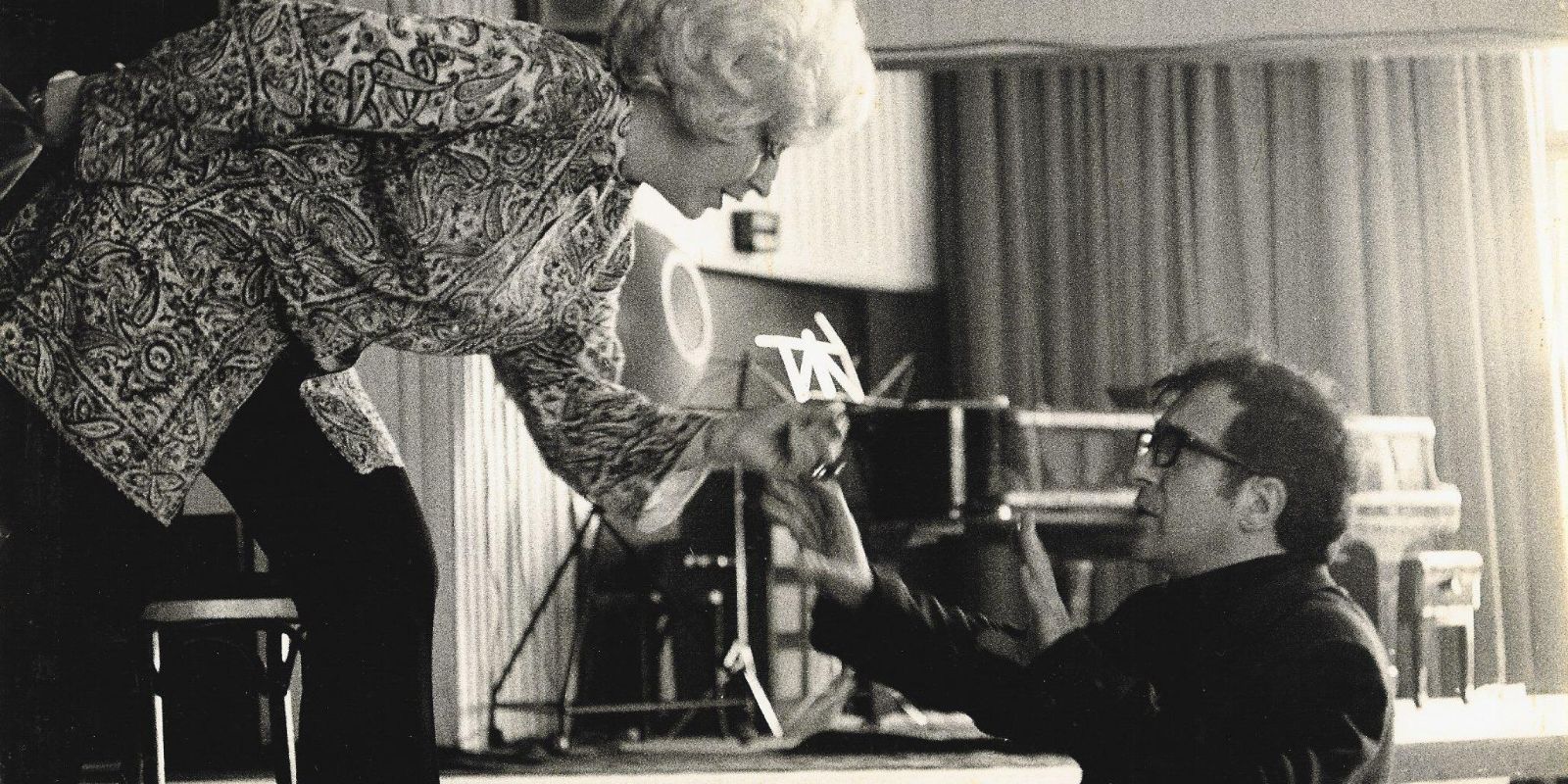
In 2025, Cathy Berberian and Luciano Berio would have celebrated their 100th birthdays. The special relationship between the two artists, which was both creative and personal is celebrated by Musikfest Berlin, especially with the concert by the Orchestre de Paris under the direction of Esa-Pekka Salonen at September 1st, and the Orchestra dell’Accademia Nazionale di Santa Cecilia and London Voices under the direction of Daniel Harding with Soprano Sarah Aristidou. I’m meeting Cristina, the day after the Musikfest Berlin premiere to talk about her mother’s legacy.
The interview took place on 30 August 2025.
Available from 4 August 2025
Reading time ca. 12 min
English

Irene Lehmann: Luciano Berio’s piece Requies is dedicated to the memory of Cathy Berberian, after her untimely passing. They met during their studies in Milano and developed a special artistic relationship. Can you talk a bit about how it all started?
Cristina Berio: Well, in 1949 my mom was 24 years old when she left her Armenian family in New York and traveled to Italy to further her voice studies with Georgina del Vigo, but by 1950 she was running out of money, so she applied for a Fulbright Scholarship. She needed a pianist to accompany her in the audition and that is when she was introduced to my father, who at the time was a composition student at the Conservatorio di Milano, and was making ends meet by accompanying singers. In her words “He spoke no English, and I spoke no Italian. We had no contact but music“. They met in May 1950, and by October 1st they were married. Clearly love at first sight.
Irene Lehmann: I imagine that music was present in your family life, not only when the two were working together in the studio. Do you remember witnessing anything of their collaborations, joint rehearsals, mutual influences?

Cristina Berio: Yes, music was the center of our lives together and theirs was a multi-levelled partnership on an emotional, musical and intellectual level, with curiosity and exploration as the common denominator. I also think that their very different cultural backgrounds was helped to stimulate each other’s creativity and open new perspectives in music.
In those earlier years, our home in Via Moscati 7, Milano, was a meeting place and breeding ground of ideas shared with musician friends and intellectuals that would often visit, not only for the music, but also for the food, since my mother was an extraordinary cook, a true culinary polyglot. Among many of those friends I remember with special fondness Bruno Maderna, Henri Pousseur, Roberto Leydi, Umberto Eco, Sylvano Bussotti and John Cage, who during his time in Milan wrote Aria for my mother, inspired by all the vocal gimmicks she would entertain him with, as they spent time together.
As the only child, I was usually present at these meetings, and my parents loved to include me in most of their activities. They would take me to their rehearsals, concerts, and when I wasn’t at school I would travel with them to Festivals everywhere, including the workshops in Darmstadt and Tanglewood. Only later in life I came to realize what an amazing childhood I had the privilege of living, being constantly exposed to music and to so many incredible people and places from a tender age. We had a stereo record player in the living room, and we would play all kinds of music. I remember listening to Stravinsky’s Le Sacre du Printemps so many times that by 7 years old I knew it by heart! So, my most extraordinary memory was when “Grandpa Igor” (that’s how I called him) came to visit us in Milan with his wife and Robert Craft, when I was about 8. For me it was like meeting the great hero of my childhood and they had to rip me away from him because I wanted all his attention. I remember my parents were also quite nervous about his visit, but the evening – and my mom’s delicious Armenian dinner – was a complete success. Later Stravinsky wrote Elegy for JFK for her. [1]
Irene Lehmann: I also read that Umberto Eco collaborated with Cathy Berberian on translations of comic books and I was wondering about the link to the onomatopoeia like „oof“ and „smash“ and so on that she later used in her composition Stripsody.
Cristina Berio: Umberto was a very close, dear friend of the family since the early 1950s (he also collaborated with my parents on Thema (Omaggio a Joyce) and at a certain point he even co-translated with my mom a couple of Jules Feiffer comic books. Translating humor is an extremely challenging task, but they both possessed a legendary sense of humor, so they had a great time doing it. Later, when my mom had the idea of creating Stripsody, a composition made of onomatopoeia in comic strips, he was the first to encourage her enthusiastically . He used to call her MagnifiCathy. Today, people use the beautiful score designed by Roberto Zamarin in music textbooks, and it’s used as an educational tool to encourage children to create their own version of Stripsody, in music classes. My mother would be ecstatic if she could only see it!
Irene Lehmann: Cathy Berberian was a highly influential, groundbreaking singer, performer, and composer who collaborated not only with her husband Luciano Berio, but also with various renowned artists, like John Cage, Sylvano Bussotti and many others. How do you see her place in music history?
Cristina Berio: Well, it’s a sensitive subject for me because I personally think not enough recognition is given to her extraordinary legacy. People tend to forget how she broke the molds of conventional perception on what a singer can and cannot do, illustrating the infinite possibilities of the human voice, “the only instrument that is inseparable from the performer”, as she used to say. She literally changed the course of vocal music. Thanks to her bold versatility and virtuosity, she revolutionized the way we now think about singing and performing, and to this day she is still an inspiration to many singers and students. Her intelligence, rapid-reflex technique and powerful stage presence inspired so many works written for her. Like, for instance, my father’s Visage, Thema (Omaggio a Joyce), Circles, Sequenza III, Recital I (for Cathy) and also Folk Songs, which my father conceived for her, as a tribute to her extraordinary artistry and the deep love of folk music they both shared. Like in everything that my mother did, there was always a lot of historical, technical, and gestural research involved, and when she performed each of the eleven culturally diverse songs, so masterfully arranged by my father, she would change her voice, or better, adjust her ”vocal attitude“ to capture the essence of each one of them. After she passed away, for many years my father would only perform Folk Songs with three or four singers, because none could do what she did alone.
So yes, I would like to see her mentioned more extensively in concert programs and publications in general, not simply as a great performer, but as a trailblazer who redefined singing and performing as we now know it.

Irene Lehmann: Recently there has been more focus given to the creative relationship between composer and performer. What was your mother’s view on aspects of co-authorship at that time?
Cristina Berio: She was asked once about this and her position was that, regardless of the tight collaboration and influence she might have had on any given piece, she did not consider herself the co-composer. In the case of Visage, for instance, she provided hours of exhausting vocal material that my father later put together, processed electronically, and created this beautifully haunting piece. She improvised for hours following my father’s prompts, but she felt he was the one who in the end brilliantly put it together.
She did however envision the singer as the co-creator of live performances, where the composer provides her with an alphabet of sounds and in return she makes poetry with it. She talks at length about this in her 1966 article The New Vocality in Contemporary Music.
I have always respected her point of view, as I understood where she was coming from and especially the times in which she lived, but I believe that in today’s world things would have been dealt with quite differently, since there’s a greater perception and appreciation for the creative role of a performer today. It’s funny, because just last week a friend sent me an article about that famous voice solo on the Pink Floyd song The Great Gig in the Sky. Apparently at the time they wanted Cathy Berberian to do it, but somehow it didn’t work out, so they found a session singer, Claire Torry, who came in and blew everyone’s mind with her improvisational solo. At the time she was simply paid her studio hours and left, but years later, in 2005, Pink Floyd added her as the co-author of the song. So, yeah, things have changed considerably.
Irene Lehmann: I saw Cathy Berberian performing her piece Stripsody on YouTube, in which we can see her changing characters and acting out comic strip vignettes strictly with onomatopoeia. How did the concert audiences react to that at the time? Do you remember?
Cristina Berio: Stripsody was a hit from the very start. My mother had a wicked sense of humor and loved entertaining her audience. And they adored her. When she was a young child, her father would create comedy gags for them to perform as a duo, so making people laugh was a natural thing for her. Later, after being hailed as the “Muse of avant-garde music” she felt she needed to break away from that mold, into new different directions, so she created a series of unique recitals that displayed the extent of her talent, not only as a singer but as an actress and also a comedian. Growing up in New York, she had studied music, literature, theater and was the lead dancer in a Folk Dance group, specializing in Armenian, Indian and Mexican dances. She commanded the audiences from the moment she stepped on stage, and even the most sceptical ones would eventually capitulate to her wit and charm. It was beautiful to watch. Those who have met her or saw her perform, will never forget her. She was a truly remarkable artist and human being, and I still miss her a lot.
Footnote:
[1] Igor Stravinsky, Elegy for JFK (1964) world premiere: version for Baritone: April 6, 1964, in Los Angeles as part of the Monday Evening Concerts conducted by Robert Craft; version for mezzo-soprano: December 6, 1964, in New York with soprano Cathy Berberian and clarinetists Paul E. Howland, Jack Kreiselman, and Charles Russo conducted by Igor Stravinsky.
Cathy Berberian’s archives are now at the Paul Sacher Stiftung in Basel, where Luciano Berio’s archives can also be found. Additional materials can be found at www.cathyberberian.com where the award-winning documentary “Cathy Berberian: Music is the Air I Breathe” is also available for streaming.
Dr. Irene Lehmann is a theatre scholar focusing on music theatre and an editor at Berliner Festspiele / Musikfest Berlin.