Text | Interview | Performing Arts Season 2025/26
In Dance Borders Become Shifting Lines of Possibility
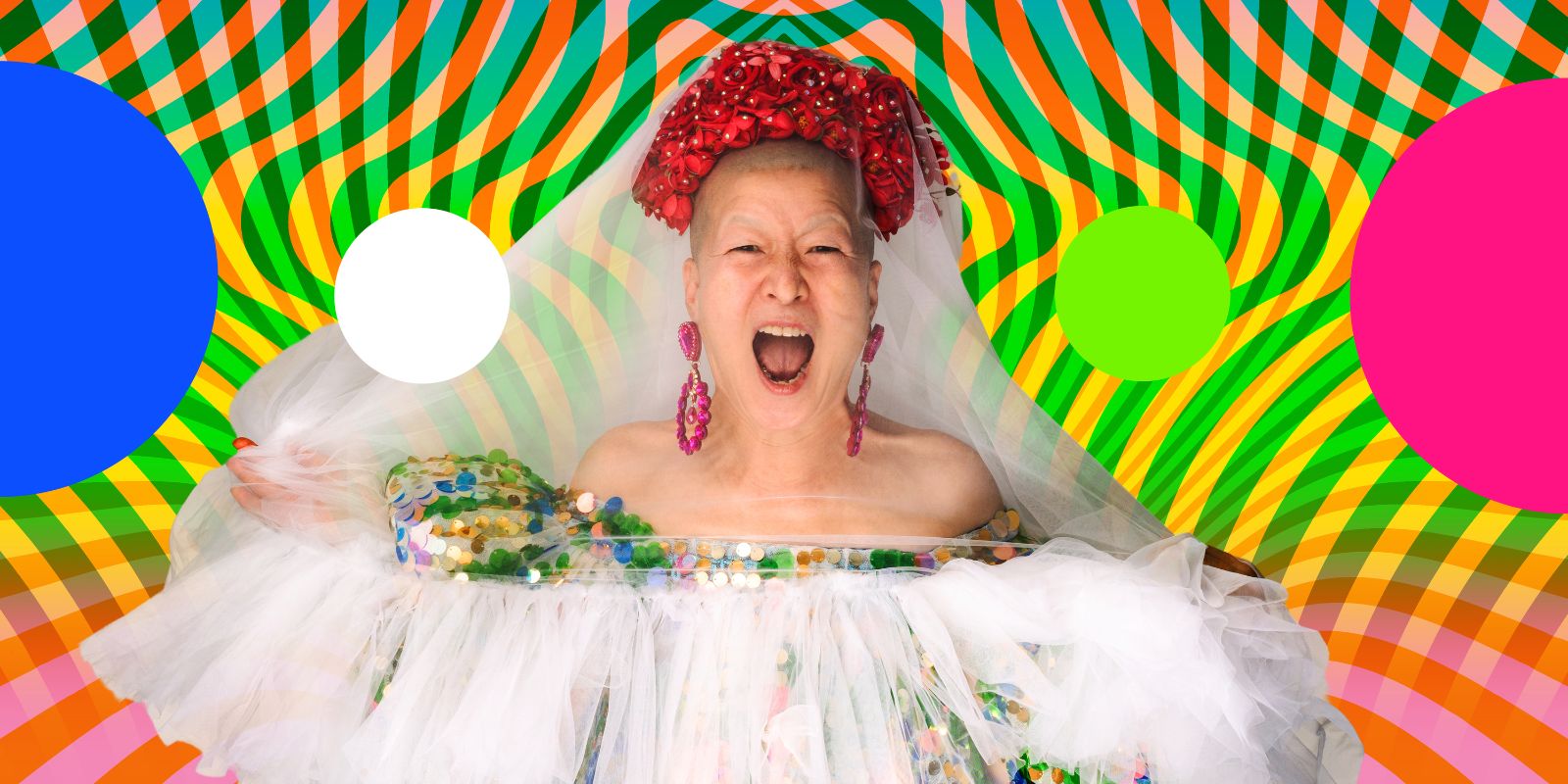
Eun-Me Ahn in conversation with Yusuke Hashimoto
Available from 16 October 2025
Reading time ca. 12 min
German and English

Eun-Me Ahn: “Post-Orientalist Express” is a journey to shatter the Western-made mirror called “the Orient” and redraw the map. It declares a step beyond the Orientalism Edward W. Said identified – the myth of an “East” constructed by the Western gaze.
The work begins from a paradox: “Everything and nothing is mine.” Audiences pass through “Erehwon” (“Nowhere”, read backwards), a topsy-turvy space where names are reversed – Aniha (China), Aeroka (Korea), Napaja (Japan) – and the power structures behind what we assume to be cultural identity are rearranged.
The crucial point is this: Orientalism is not only a Western gaze. Within Asia, we also Orientalize one another. Recognizing this dense web of mutual othering – Korea toward Japan, Japan toward China, China toward Korea – I realized that simple rejection was impossible; it already lives within and among us. So I chose strategic essentialism: rather than discarding this tangled field of fact and fantasy, I reclaim it as a shared human resource that collapses the old East/West hierarchy – borrowing traditions, constantly shifting their expressions, recombining them, and creating new meanings.
Yes – but the method matters. I believe in a third path: Both/And, not Either/Or. Bridging does not erase difference; it honours each culture on its own terms and keeps the friction at their points of contact alive. Not unity but dialogue; not a single voice but harmony.
Choreographically, the crucial stance was not “Pan-Asian” but “Inter-Asian”. A fictional “unified Asia” would only reproduce Western Orientalism from within. Instead, I use difference and tension themselves as raw material: the yin-yang circle crossing the straight line of Noh, a Kathakali mudra weaving between them. Such dissonances create a new rhythm – the dance of Inter-Asia.
In the 21st century, we need not remain defensive. Creation flourishes when we treat our internal complexities – friction, misunderstanding, even conflict – as fuel. “Post-Orientalist Express” understands culture not as a vertical hierarchy but as a horizontal flow, staging “invented traditions” that are endlessly remade within that stream.
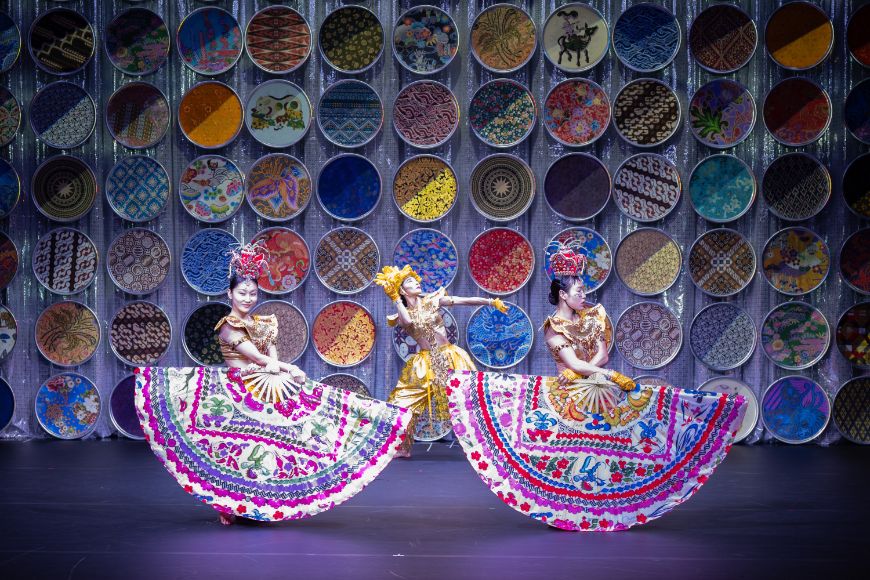
Post Orientalist Express, Eun-Me Ahn, 2025
My movement is a physical language that shuttles between ritual and play. Shamanism taught me that the body is not just a tool of expression but a medium that communicates with the world and catalyzes change. A shaman’s dance is not a performance for spectators; it is a passage between gods and humans, life and death, past and present – charged with trance, healing, and transformation. Contemporary dance, by contrast, trains a secular, critical vocabulary – deconstruction, rupture, individual expression. I don’t oppose the two; I channel shamanic energy through contemporary form.
So my vocabulary emerges where the sacred turns secular and the absolute becomes relative: violent tremors, circular spins, sudden arrests and eruptions – energies of gut (Korean shamanic rite), yet deliberately composed within a contemporary syntax.
In “Post-Orientalist Express”, these forms converse around tradition and the present. Noh, Jingju (Peking opera), Kathakali – all contain shamanic residues: communing with spirits, conveying stories, transforming the world. I recompose them in a contemporary critical language, recalling tradition not as something fixed but as something perpetually reinvented.
Where the sacred becomes secular, and tradition turns toward the future – that is the essence of their dialogue. In this sense my body moves as both shaman and modern artist, traversing and dismantling the boundaries of past/future, East/West, sacred/secular. “Post-Orientalist Express” makes that doubleness explicit.
Most of us live inside invisible categories – “you are Korean,” “you are a woman,” “at this age you must live this way.” These function like social choreography, prescribing how bodies should move. I try to make this hidden score visible – and then break it.
When a woman in her sixties dances ferociously, or a male dancer embodies traditional femininity, the command “you must be this” shifts into the possibility “I can also be that.” Words are often tainted by established power – “woman”, “Oriental”, “tradition” all carry someone else’s gaze – but a dancing body speaks from before or beyond those terms.
When my sixty-year-old body lifts like a girl’s, when a “Korean” body contains multiple cultures at once, it declares: I cannot be reduced to a single category. Audiences begin to sense the choreography society has inscribed on their own bodies. Dance rewrites the script – and in the new script, borders are not walls but shifting lines of possibility. That is the world I dream through dance.
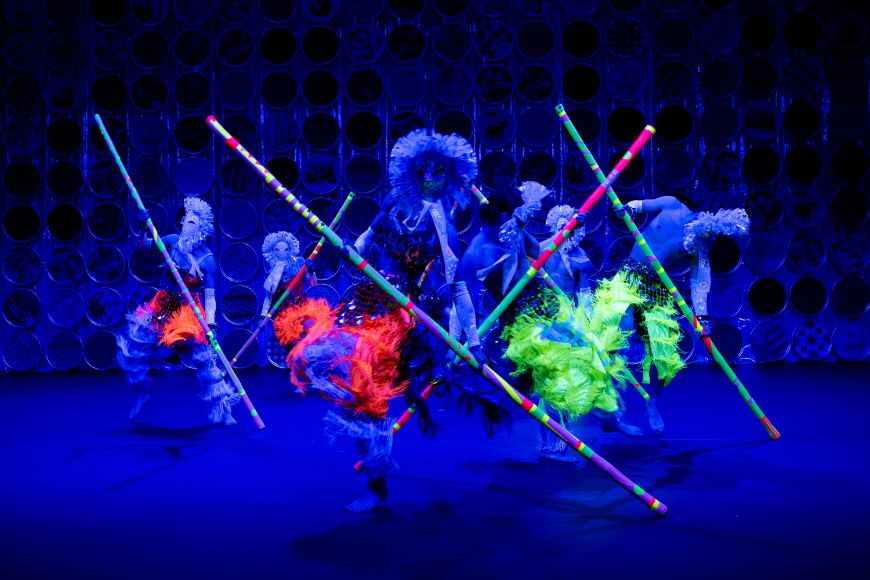
Post Orientalist Express, Eun-Me Ahn, 2025
I grew up witnessing the streets of Korea’s democratization. Those turbulent years etched questions in my memory about how dance should work. Globalization, meanwhile, created confusion about what counted as “Korean”. Tradition moved into museums; Western culture became everyday. In that confusion I could let go of the fantasy of “pure tradition” early.
The long, difficult work of forging my own language led to “Anthropology of the Body”, a dancing trilogy consisting of “Grandmother”, “Teenagers”, “Middle-Aged Men” – three bodies where Korean power structures are most clearly inscribed: sacrifice and devotion, control and exam competition, patriarchy and authority. I wanted to step outside such neat labels, search for a common denominator across generations, and capture a modern history of the body through dance. If democratization altered political systems, dance could recall and reinterpret memory inscribed in the body.
If the trilogy dealt with power inside Korean society, “Post-Orientalist Express” turns its gaze outward – to relations between Asia and the West. Yet the core remains the same. As democratization taught me, I do not stop at critiquing Western Orientalism; I face our internal hierarchies – the mutual othering among Asian nations, the binary of tradition/modernity – and use them as material for creation. Living through globalization taught me there is no pure “us”; everything is already mixed, and hybridity is strength. “Post-Orientalist Express” is the crystallisation of that insight.
Democratization taught me how to resist; globalization taught me the fluidity of identity. Together they fuel a practice that dismantles fixed power while imagining new forms of solidarity.
Colour is in many ways the reason I went into dance, so it has always been deeply important to me. As a child of five or six, I would run alone over the village hills. One day I encountered people dressed in dazzling colours. In the years just after the war, most clothing was only black, gray or navy. I asked, “what is this?” and someone answered, “Dance.” In that moment, an entirely new world opened. Even at that age I sensed that colour carried energy – and perhaps that is also why I was later drawn to shamanism.
When I first began creating, I experimented with working alongside designers. But explaining what I wanted often took too long, and sometimes the results didn’t function with the movement itself. As an artistic director I understand beauty, but as a dancer I also know how essential functionality is – especially for rapid changes during performance. In this work, each performer wears more than ten costumes. That means costume cannot be merely something you wear; it must be part of the dance, an extension of the movement itself.
In “Post-Orientalist Express”, costumes align with the idea of reinventing tradition, not preserving it. I studied various traditional garments and reinterpreted them in my own way: the lines of the hanbok, the layering of the kimono, the draping of the sari – recognizable, yet utterly transformed into glittering, exuberant forms. Not preservation, but reinvention.
Historically, colour carried hierarchy. I overturn this order. Neon hues, vinyl textures, kitsch adornments – elements once dismissed as “cheap” – are brought to the forefront, revealed in their powerful energy. Just as vivid colours once opened a new world for me in the gray landscape of post-war Korea, colour here becomes a language of liberation, breaking through systems of power and rank.
In “Post-Orientalist Express”, costume is not a fixed identity but a mask in constant transformation. Dancers change outfits many times on stage, demonstrating that cultural identity is not essence but something to be chosen, recombined, reimagined.
Ultimately, the palette and wardrobe in my work are not tools of reproduction but of invention – devices for creating the present and imagining the future. They are my perspective of continuing to unfold the wondrous world of colour that a six-year-old girl once glimpsed on a hillside.
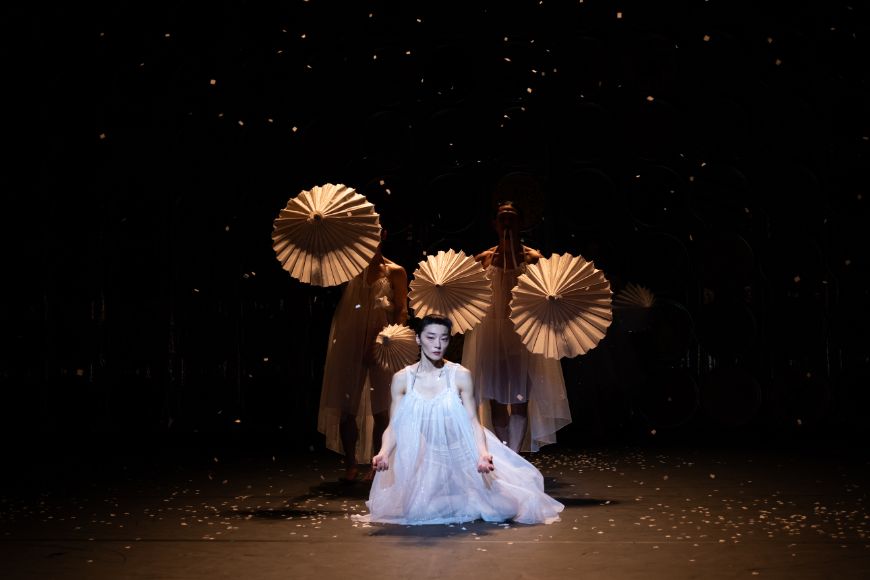
Post Orientalist Express, Eun-Me Ahn, 2025
I hope audiences leave with a sensory experience and a new way of seeing. Like the paradox “everything and nothing is mine,” I want you to encounter the strangeness that emerges when things are mixed – until the question, “whose is this?” begins to dissolve.
“Post-Orientalist Express” is not merely a stage work; it is a forum where audiences and artists share both process and concept. Together we explore a world of Both/And rather than Either/Or: flows instead of categories, crossroads instead of hierarchies, and the creative tension that arises at those intersections.
The idea of Inter-Asia that we tested here treats Asia’s internal differences as raw material – and it carries the potential to travel elsewhere. One might imagine, for instance, a Senegalese dancer re-seeing a Southern African form, or an Egyptian choreographer reappropriating an Ethiopian tradition – frictions, misunderstandings, and acts of creation unfolding at once. If such “Inter-”practices expand and encounter one another, they could offer a new model of imagination that links continents without erasing internal complexity.
Above all, I hope viewers will not confine this work to the “East”, but instead use its methodology as a springboard for their own thinking and imagination. That is why I invite you on this journey – and what I most wish for you to take away.