Text | Essay | Performing Arts Season 2026/27
GLA55. 10 Movements to the Music of Philip Glass
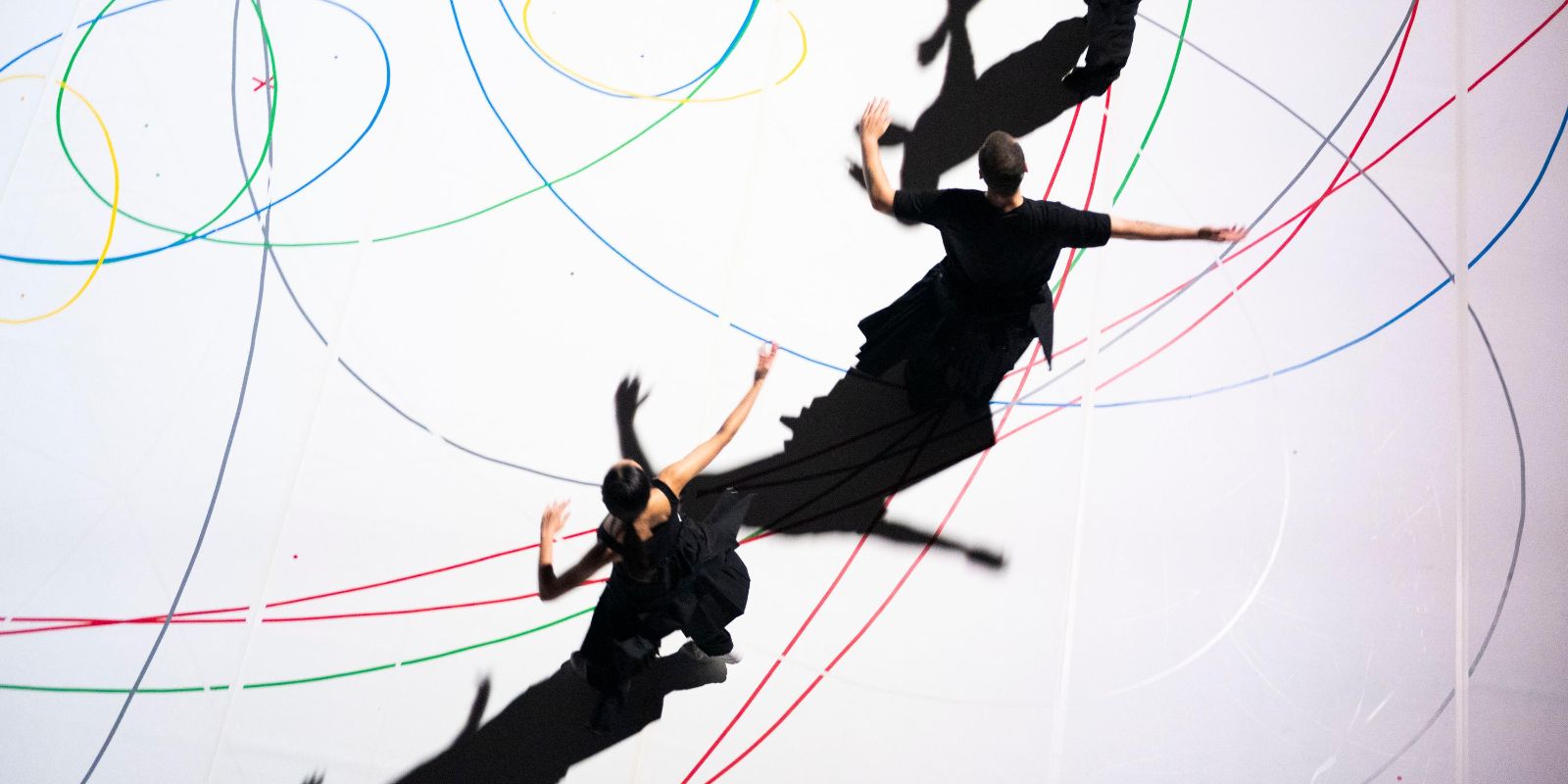
“What music would I like to dance to?” If one were to imagine Anne Teresa De Keersmaeker’s artistic process as a circle, this question, in all its naïve simplicity, would lie at its very centre. GLA55 began with the chance listening to Icons. The American Minimalists, a recording by BL!NDMAN, the ensemble led by Eric Sleichim.
“That recording took me back to my starting point as a dancer and choreographer: the American minimalists. But it also brought me back to my earliest musical companions along the way: Eric [Sleichim] and Ictus.” Both BL!NDMAN and Ictus would later emerge from the band Maximalist, which provided the music for Rosas danst Rosas. Now the two ensembles join forces to perform early works by Philip Glass.
Available from 9 November 2026
German and English

Repetition and Variation
Together with De Keersmaeker, Eric Sleichim (BL!NDMAN) and Jean-Luc Plouvier (Ictus) selected four of Glass’s signature works, all composed between 1969 and 1970. These years marked the high point — and also the end — of a period of intense artistic friendship and productive rivalry between the two most influential minimalists, Reich and Glass. After this, they would not speak to each other for forty years.
“It was immediately clear to me that this music offered a powerful invitation to dance, and to write dance as well,” says De Keersmaeker. “Its form is extremely consistent and rigorous. This is music that plays out the tension between two fundamental principles in art to the fullest: repetition and variation. Repetition, especially in music, brings us into a state of trance, even ecstasy — which literally means to ‘stand outside oneself’. As I dance, I experience the repetitive quality most strongly when I make turning movements: it leads to the strange sensation of dissolving, as it were, into my own inner world. Set against the power of repetition is its opposite: variation. Variation does something different. The moment a repetitive structure changes, it engages our desire to detect patterns and sharpens our attention to the smallest difference. This attention to minimal changes draws our attention back outwards. These two movements in the way we experience music — and perhaps life more broadly — this tension between turning inwards and turning outwards, like breathing, may well be what attracts me to music in the first place.”
“Another tension I find in Glass’s early music is one that has fascinated me throughout my career: that between strict, mathematical formalism and visceral — and therefore bodily — energy. This is especially true of the original way Jean-Luc [Plouvier] and Eric approach the performance: energetically, with enormous precision, yet also with a freedom within that precision that sometimes reminds me of rock music, and at other times of the energy of an Irish folk band such as The Chieftains.”
Plouvier and Sleichim have opted for a radically non-academic performance — Glass himself, throughout his career, was careful to keep his music outside academic institutions. In terms of sound, their interpretation belongs firmly to the present: carefully constructed synthesiser sounds, electric guitar and saxophones, alongside a violin technique whose bowing and ornamentation often evoke the fiddle of Irish folk music. At its heart, Irish folk is dance music, just as much concerned with repetition and variation.
At the same time, this approach, both precise and free, remains remarkably faithful in its emotional character to the original context in which this music was created and performed: psychedelia, rock music and the rock ’n’ roll of the New York art scene in which Glass moved.
Dancing Like Planets
“Music is generally my greatest source of nourishment when choreographing. At the same time, I am always looking for choreographic systems that exist autonomously, independently of the music. The pieces thus become an encounter between two logics: a musical one and a choreographic one. In this project, a partial uncoupling of dance and music was, in fact, inevitable: the mathematical complexity of the music makes it impossible for the dancers to count it. Although Glass’s pulse is very strong, the dancers do not use it as a timekeeper, but rather as an energetic heartbeat. The challenge, then, was to find simple choreographic principles that I could subject to a set of rules — perhaps ‘game rules’ is a better term — just as Glass does. These rules allow simple basic material to generate a complexity that appears, to a large extent, free.”
“Just as Glass begins with a five-note melody that can be played up and down with one hand, I begin by defining little more than two or three basic movements. The first is the fundamental posture: throughout the piece, the dancers dance with one arm extended, palm facing upwards, while the other arm is bent, palm facing downwards. Towards the heavens and towards the earth, along the vertical axis that defines the human being. A second basic movement is turning. Throughout the choreography, we see variations on turning: sometimes around their own axis, sometimes along drawn spirals, and predominantly along ellipses. The entire choreography is, in fact, a search for ways of dancing on ellipses. And the movement I find most striking — almost mystical, to be honest — is that of the lemniscate, the horizontal figure eight, the symbol of infinity. As always in my work, the entire system of variation is held together by a geometric ground plan: a circle containing a pentagram, from which a system of spirals on the one hand and ellipses on the other emerges, arranged across six scales. Each dancer moves on a different scale, represented by a different colour. The proportions between these scales follow the Fibonacci sequence. The smallest ellipse corresponds to the space occupied by a human being turning around their own axis; this scale of the human body is then enlarged sixfold. The largest ellipse extends partly beyond the stage. Likewise, a spiral that unfurls from the central pentagram eventually curls outwards, towards the world and, ultimately, the cosmos.”
You Fuck Yourself, You Fuck the Others
When these rules are applied to six dancers, each moving on a different scale, the result is a counterpoint of almost impossible complexity to write down. The dancers skim past one another, coming perilously close, and must adjust their speed to one another to avoid collisions. This creates tension within the choreography and demands an extraordinary degree of alertness from the dancers.
Like a flock of starlings in a murmuration, they must constantly keep an eye on their fellow dancers while remaining precisely aware of their own position along their trajectory, even as they are perpetually in motion. Although the choreography contains no lines, the dancers continuously create shifting sightlines between one another and the audience, like the rotating axes of a whirling map.
“The choreography therefore requires the dancers to organise themselves in the moment, to constantly tune in to one another. You fuck yourself, you fuck the others. In this sense, it is also a social metaphor. The basic movement — the extended arm — makes the risk of collision even greater. There are constant close encounters. But it is precisely this delicate balance between risk and mutual care that creates the tension.”
This state of hyper-alertness means that the dance is less like the “performance of a written score” and more like a complex game played by highly skilled players — a game that looks different every evening.
What it All Comes Down to
“You could say that the entire choreography is a tribute to Johannes Kepler, who discovered in the seventeenth century that planets move in ellipses rather than circles. An ellipse is a fascinating shape: its mathematical definition is ‘a circle with two centres’. This inherent duality is intriguing. It invites oscillation, a pendulum-like movement whose speed — just as with the planets — is never constant. This is also an important principle in the choreography: the dancers must ensure that their speed remains in constant relation to their position on the ellipse. The closer they get to the turning point, the faster they move, and vice versa. They are therefore always either slowing down or speeding up.”
This duality, this way of looking through two different lenses, can also be applied to GLA55. On the one hand, the turning in GLA55 imitates the celestial sphere, the macro with a capital M: human beings imitating planets, dancers “playing at being little planets”. In this way, turning and spinning connect with an ancient mystical tradition in which circular movement serves as a means of losing oneself through the imitation of the cosmos. Think of the whirling dervishes of the Sufi rituals established by the thirteenth century Sufi poet Rumi: dance as prayer, as meditation.
Seen from this perspective, GLA55 can be understood as a ritual that reconnects with premodern “techniques” for placing oneself in a healthy, humble relationship with the cosmos. A way of “re-proportioning” ourselves as human beings, so that the proportions fall back into place.
At the same time — and here we arrive at the second centre of this elliptical way of looking – turning becomes a visual representation of what the philosopher Paul Virilio called “stasis dromologique”, or what Hartmut Rosa, following in Virilio’s footsteps, described as “rasender Stillstand”: the speed required to keep pace with the ever-accelerating speed of our time, a speed that has become unbalanced, lest we fall backwards into the abyss.
This frenzied standstill demands that all our time and energy be devoted to keeping the fastmoving system itself running. It deprives us of the ability to think and experience on larger timescales: to situate ourselves within history, to imagine broader narratives of the future. It is the nightmarish inversion of what meditation does: spinning around, trapped in a hellish, revolving here and now.
GLA55 offers glimpses of both states: the frenzied standstill, and that which might free us from the suffocating vortex of the present, which obscures our view of larger scales of time and space. GLA55 transforms spinning around into an experience that — we dare to say it — might be mystical. Not in the sense of pointing towards transcendence, but precisely the opposite: towards the wonder of what exists, and the wonder that it exists at all.
(Go on, try it for yourself: stand up and begin turning around your own axis. Imagine that you are doing so on a rotating planet, spinning on its axis and orbiting the sun, within a revolving solar system, inside a rotating galaxy. All these things exist, and so do you. And if you can feel that this apparent banality is also the greatest wonder of all, then you are re-enchanting something that has been disenchanted. You are – still spinning – turning something back in a vital way.) But this promise, this far-reaching vision, is always limited too: as long as the turning lasts, the mystical glimpse remains.